Pervasive and programmed nucleosome distortion on single chromatin fibres
Nature News ·
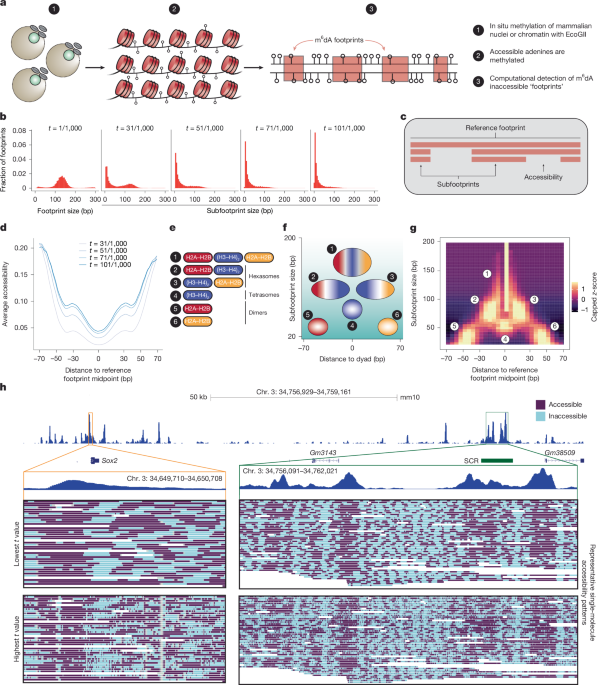
SAMOSA from E14 mouse ES cells We compiled a large compendium of SAMOSA data from wild-type E14 mouse ES cells, comprising both newly generated datasets and published datasets from our laboratory, …
SAMOSA from E14 mouse ES cells We compiled a large compendium of SAMOSA data from wild-type E14 mouse ES cells, comprising both newly generated datasets and published datasets from our laboratory, including: (1) our study on the function of ISWI-family remodelling complexes 3 ; (2) samples prepared with our SMRT-Tag protocol, which uses a transposase-based strategy for PacBio library preparation from lower input amounts of footprinted DNA 38 ; and (3) mouse ES cells labelled with the halogenated thymidine analogue BrdU for varying time points in our study of single-fibre accessibility patterns in newly replicated chromatin 52 . Only samples with a mononucleosome–dinucleosome ratio (MDR; calculation detailed in ‘Data analysis and visualization’) greater than 10 were included for analysis. All cell lines were routinely tested for mycoplasma contamination. No statistical models were used to predetermine sample size. Neither blinding nor randomization was used. Cell culture For newly generated libraries, E14 mouse ES cells were grown on gelatin-coated (0.1% solution in 1× PBS) tissue culture plates. Cells were cultured in mouse ES cell medium (DMEM with GlutaMAX (Thermo Fisher Scientific, 10566-016)), supplemented with 15% fetal bovine serum (FBS; Thermo Fisher Scientific, SH30071.03), 14.2 mM 2-mercaptoethanol (Bio-Rad, 1610710), 1× NEAA (Thermo Fisher Scientific, 11140-50), 1 mM sodium pyruvate (Thermo Fisher Scientific, 11360-070) and 1× LIF (purified by the laboratory of B. …
Original source: Nature News