Do octopus brains work like humans’ — or is there another way to be smart?
Nature News ·
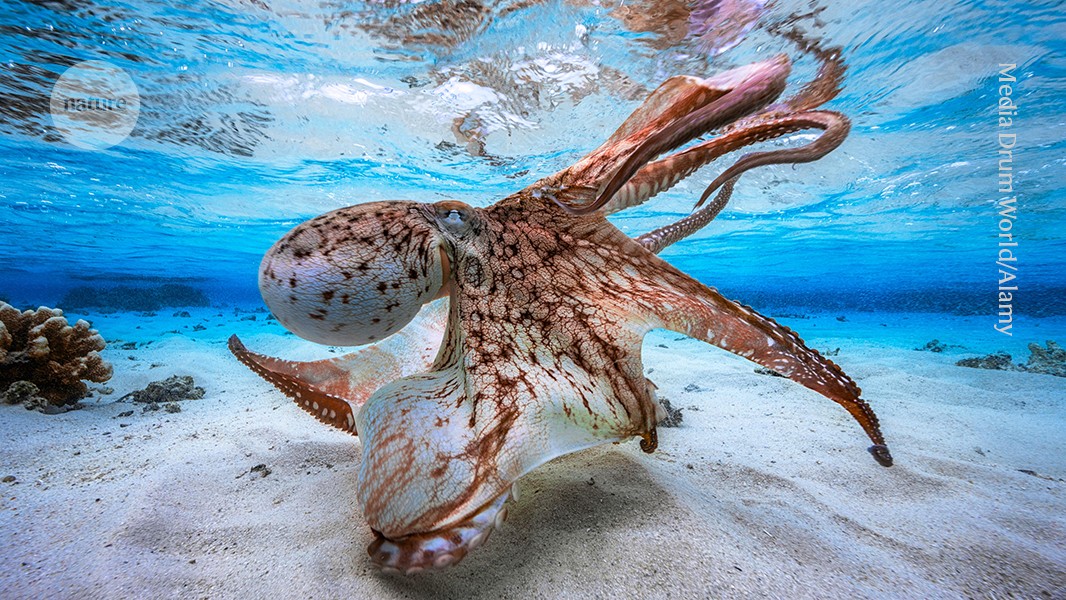
Three hearts; blue blood; no skeleton; arms like tongues. These are just some of the alien features of octopuses, squid and cuttlefish — members of the cephalopod family. …
Three hearts; blue blood; no skeleton; arms like tongues. These are just some of the alien features of octopuses, squid and cuttlefish — members of the cephalopod family. The outlandish list continues. Cephalopod skin can taste chemicals , sense light and change colour and texture rapidly . In many species, the sucker-covered arms can even regenerate. Cephalopods deserve higher welfare standards in research These invertebrates have evolved independently from the vertebrate lineage for more than 600 million years. Their last common ancestor was probably a worm-like creature with a rudimentary nervous system and eye-like patches of light-sensitive cells. Despite this evolutionary gulf, vertebrates and these highly specialized molluscs share strange similarities. Their eyes, for example. “It’s eerie how similar they ended up,” says Cristopher Niell, a neuroscientist at the University of Oregon in Eugene. “The convergent evolution of the eye still blows my mind.” Now, one similarity is spurring a boom in cephalopod neuroscience . Around 400 million years ago, cuttlefish, squid and octopuses diverged from the only other living cephalopods — the nautiluses. They then lost their protective shells and evolved brains that are uniquely large among invertebrates. These brains bestow the soft-bodied cephalopods with high intelligence. …
Original source: Nature News
Mentioned
Vertebrates · California · Massachusetts · Harvard University · University of Chicago