First detailed 'smell map' reveals how noses track odours
Nature News ·
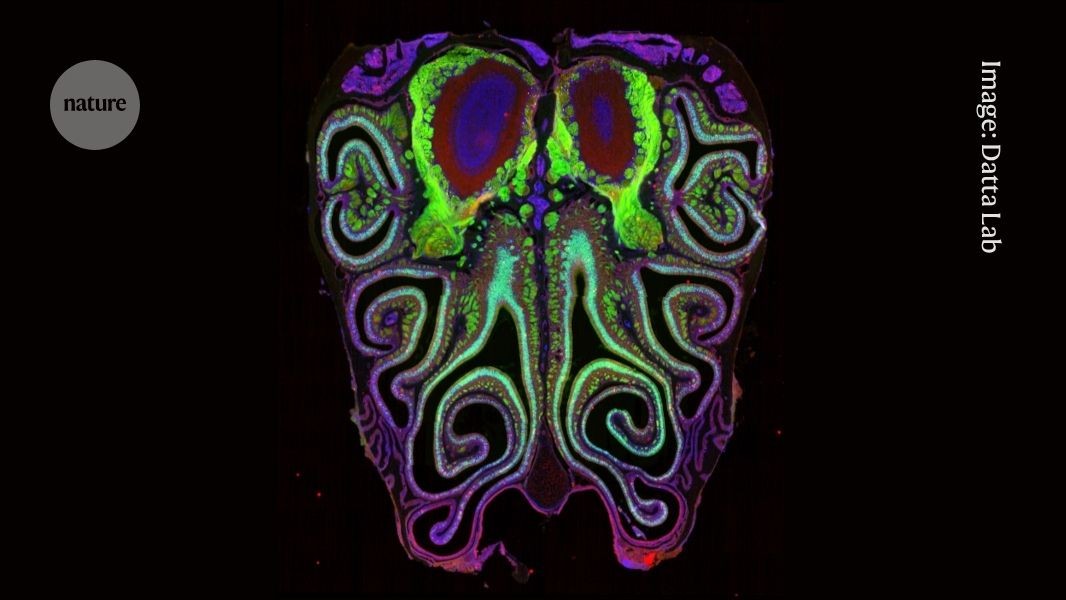
A microscope cross-section image of a mouse nose, showing the anatomical structure of the nasal epithelium. Credit: Datta Lab Olfactory receptors in the mouse nose have been mapped out in …
A microscope cross-section image of a mouse nose, showing the anatomical structure of the nasal epithelium. Credit: Datta Lab Olfactory receptors in the mouse nose have been mapped out in unprecedented detail — overturning researchers’ understanding of how noses build a sense of smell. The research, published today 1 in Cell , shows how around 1,100 olfactory receptors expressed on sensory neurons are organized in tightly regulated spatial locations in the epithelial tissue that lines the nasal cavity. These nasal receptor maps match smell maps in the olfactory bulb of the brain. “For 30 years, we’ve taught students that the mouse olfactory epithelium is divided into a handful of broad zones, within which receptor choice is essentially random,” says Johan Lundström, a psychologist and experimental neuroscientist at the Karolinska Institute in Stockholm. “This is a landmark paper that overturns one of the foundational textbook models of olfactory organization,” he adds. Smell stripes In the study, researchers examined about five million neurons from hundreds of individual mice. They first used single-cell sequencing to identify which smell receptors were expressed by neurons in the nose, and then used spatial transcriptomics to map out where key genes are being expressed. This allowed them to pinpoint where the receptors are and show that they are always arranged in horizontal stripes running from the top of the nose to the bottom. …
Original source: Nature News
Mentioned
Stockholm · Philadelphia · Pennsylvania · Boston · Massachusetts · Harvard Medical School