'Dancing' jets erupting from a cannibalistic black hole have the power of 10,000 suns
Space.com ·
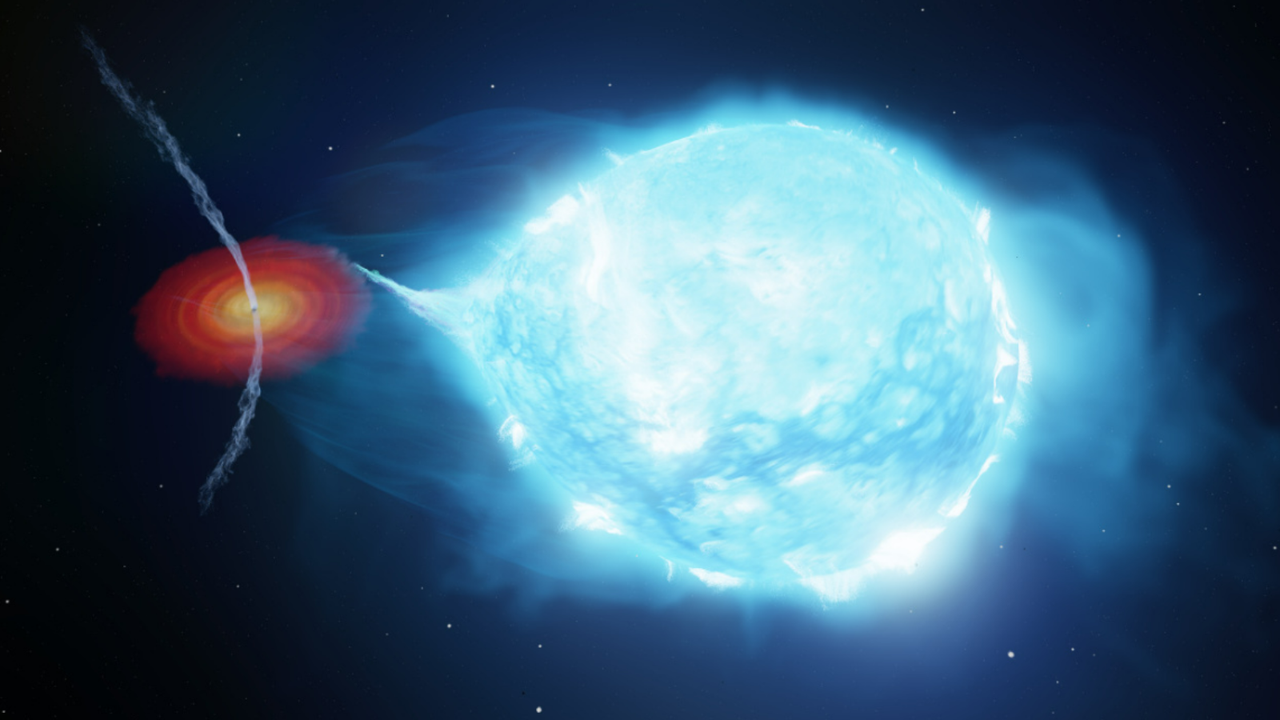
Astronomers watched as jets blasting from a black hole cannibalized a blue supergiant companion star. Data from the Square Kilometre Array Observatory (SKA) radio telescope allowed the team to …
Astronomers watched as jets blasting from a black hole cannibalized a blue supergiant companion star. Data from the Square Kilometre Array Observatory (SKA) radio telescope allowed the team to measure the power of these outbursts, finding them as powerful as the output of 10,000 suns, which could help to reveal how they shape entire galaxies around them. The system studied by the team is known as Cygnus X-1 (Cyg X-1), located 7,000 light-years away and one of the brightest sources of X-rays in the sky. Cyg X-1 is thought to consist of a stellar-mass black hole estimated to have around 21 times the mass of the sun, which is feeding from a blue supergiant star. The black hole and its donor star are separated by just 30 million miles (48 million kilometers), which is around 20% of the distance between Earth and the sun (0.2 astronomical units). The blue supergiant star is supplying the Cyg X-1 black hole with material via powerful stellar winds blowing from it. This matter can't fall straight to the black hole, though, as it has angular momentum, or spin. Instead, it forms a flattened swirling cloud called an accretion disk that gradually feeds the black hole. The immense gravity of the black hole heats the accretion disk, causing the powerful X-ray emissions associated with Cyg X-1. Not all of this matter finds its way into the black hole, though. Some is channeled to the poles of the black hole from where it is blasted out as powerful jets. …
Original source: Space.com
Mentioned
Earth · South Africa · Western Australia · University of Oxford