Interstellar invader comet 3I/ATLAS formed in a world much colder than the solar system
Space.com ·
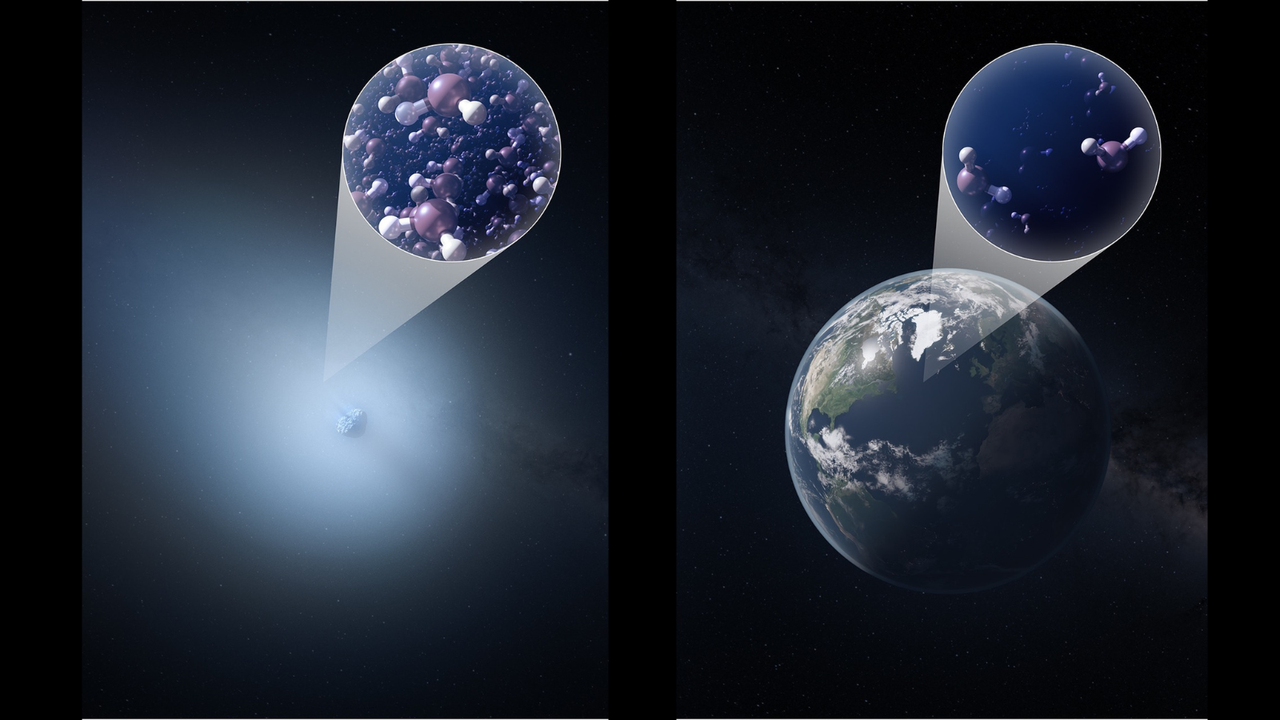
Using the Atacama Large Millimeter/submillimeter Array (ALMA), scientists have discovered that the interstellar invader comet 3I/ATLAS formed in a much colder region of the Milky Way than our solar …
Using the Atacama Large Millimeter/submillimeter Array (ALMA), scientists have discovered that the interstellar invader comet 3I/ATLAS formed in a much colder region of the Milky Way than our solar system. The discovery came about when scientists made the first-ever measurement of so-called semi-heavy water (or deuterated water) for an object that originated beyond the solar system. Deuterated water refers to water in which one hydrogen atom is replaced with deuterium, a heavy hydrogen isotope that has an atomic nucleus composed of one proton and one neutron. ALMA's measurements of deuterated water revealed that 3I/ATLAS contains around 30 times as much semi-heavy water as is found in comets that originate in the solar system . The findings indicate that 3I/ATLAS, just the third interstellar object discovered passing through the solar system, formed in a much more frigid region of space compared to our planetary backyard. "Our new observations show that the conditions that led to the formation of our solar system are much different from how planetary systems evolved in different parts of our galaxy," team leader Luis E. Salazar Manzano at the University of Michigan said in a statement . Manzano and colleagues studied 3I/ATLAS as it reached its closest point to the sun, a feat made possible by the ability of ALMA's 66 radio antennas to point toward the sun , something optical telescopes can't do because of the glare of sunlight. …
Original source: Space.com