James Webb Space Telescope peers into a dying star surrounded by mysterious buckyballs: 'The structures we're seeing now are breathtaking'
Space.com ·
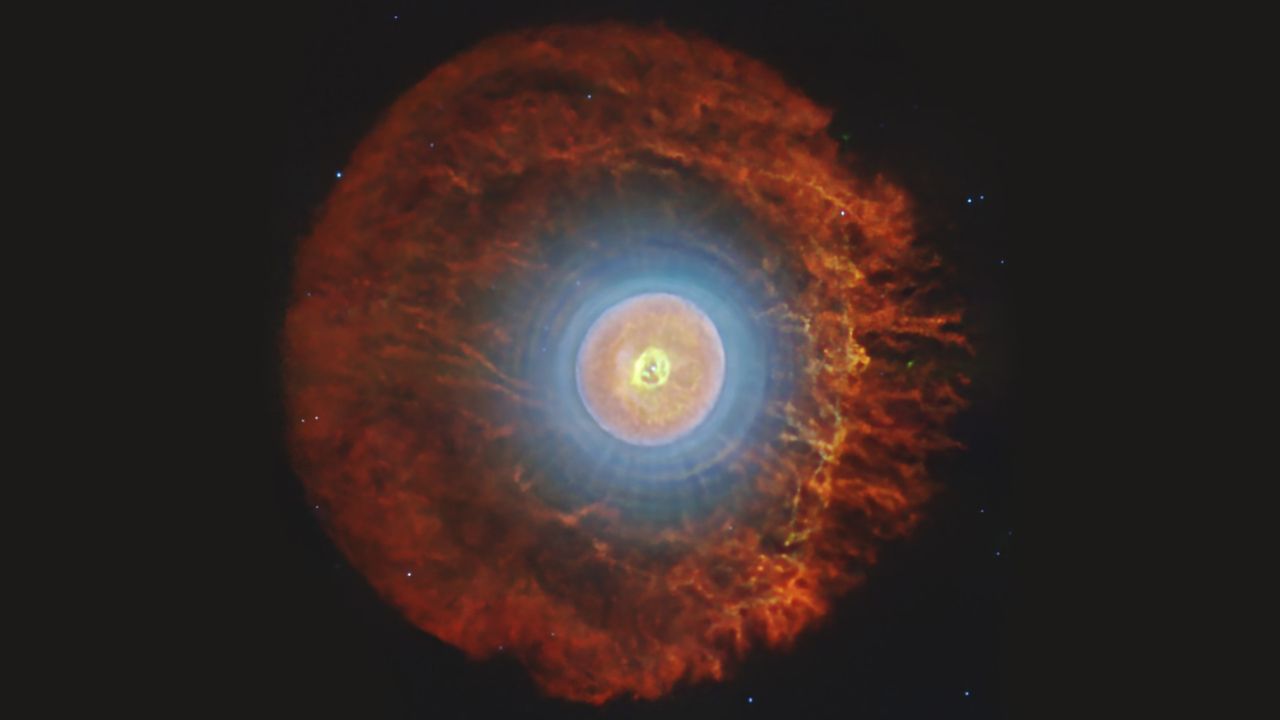
The spectacular birthplace of weird carbon molecules known as "buckyballs" came to light in new imagery of a nebula from the James Webb Space Telescope. …
The spectacular birthplace of weird carbon molecules known as "buckyballs" came to light in new imagery of a nebula from the James Webb Space Telescope. The gas cloud includes an upside-down question mark shape, which marks a structure scientists don't yet understand. The James Webb Space Telescope (JWST) peered 10,000 light-years into space to trace the origin of buckyballs, which are large and hollow molecules resembling a soccer ball. The gas cloud the observatory imaged, known as Tc1, came from a dying star, in the constellation Ara (Latin for "alter") in the southern hemisphere. "Tc 1 was already extraordinary, as it was the object that told us buckyballs exist in space, but this new image shows us we had only scratched the surface," Jan Cami, a physics and astronomy professor at Western University in Canada, said in a statement . "The structures we're seeing now are breathtaking, and they raise as many questions as they answer." Cami also led the team that first found cosmic buckyballs in 2010, a discovery notable enough to be published in the journal Science . That study was conducted using NASA's Spitzer Space Telescope which, like JWST, observed in infrared wavelengths. But Spitzer's mission ended in 2020. JWST, which has a larger mirror and is further away from Earth, can now pick up where Spitzer left off and zoom in on the details. Ingredients of life Buckyballs are more properly known by their chemical name, buckminsterfullerene. …
Original source: Space.com
Mentioned
Canada · Science · Western University · University of Sussex · James Webb Space Telescope