Competing programs shape cortical sensorimotor–association axis development
Nature News ·
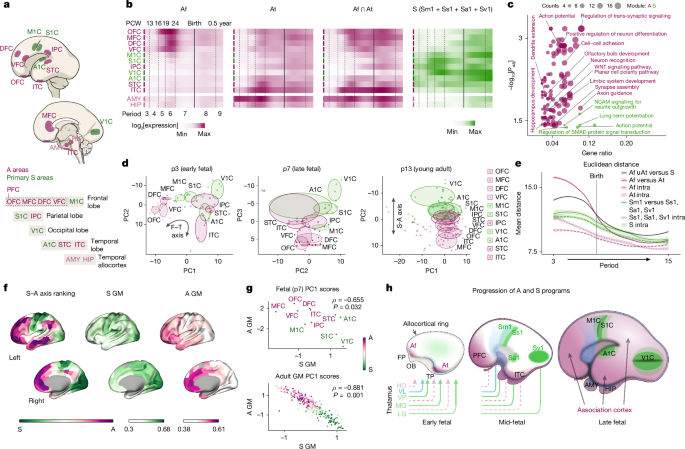
Association and sensorimotor gene module curation Independently generated spatiotemporal human brain exon microarray data and RNA-seq datasets were obtained from ref. …
Association and sensorimotor gene module curation Independently generated spatiotemporal human brain exon microarray data and RNA-seq datasets were obtained from ref. 26 (accessed through https://hbatlas.org/ ) and ref. 28 (accessed through http://development.psychencode.org/# ) and the developing macaque brain RNA-seq data across brain regions were obtained from ref. 29 (accessed through http://www.evolution.psychencode.org/# ). The estimated correspondence between macaque developmental timepoints and equivalent human developmental periods has been reported previously 29 . We split association areas representative of pericentral programs into two groups: Af, which included the OFC, MFC, DFC/dlPFC and VFC; and At, which included the posterior STC and ITC. Sensorimotor groups representative of central programs contained M1C, S1C, A1C and V1C. Areas dissected during fetal development are depicted in Fig. 1a . When defining our GMs, we used human samples from period 3 to period 7 and macaque samples from predicted period 5 to predicted period 7 with at least two biological replicates for each predicted period (the earliest macaque sample corresponded to approximately human period 4 and there were no biological replicates). For each of the three sequencing datasets (human microarray 26 , human RNA-seq 28 and macaque RNA-seq 29 ), we conducted differential expression analysis using all samples across ten regions for each period. …
Original source: Nature News