Aerosols and hydrocarbons in the atmosphere of a white dwarf planet
Nature News ·
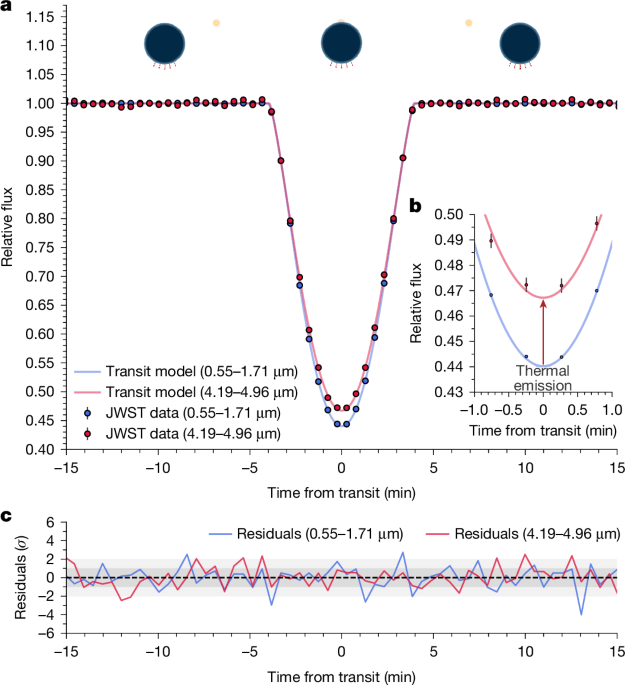
Data reduction Our PRISM observation used 33 groups across 240 integrations, with each integration lasting 29.8 s, for a total observing time of 1.98 h. …
Data reduction Our PRISM observation used 33 groups across 240 integrations, with each integration lasting 29.8 s, for a total observing time of 1.98 h. Although the transit duration of WD 1856 b only lasts 8 min, we selected this observing window to ensure JWST captured a transit of WD 1856 b with sufficient out-of-transit baseline for detector settling. We used two independent codes to reduce the NIRSpec PRISM observation of WD 1856 b and extract transmission spectra: FIREFLy and Juniper. Here we detail the reduction and light curve fitting approach used by each code. FIREFLy We first reduced the WD 1856 b data using the Fast InfraRed Exoplanet Fitting Lyghtcurve (FIREFLy) 13 , 29 , 30 reduction suite. The reduction started with the uncalibrated (uncal.fits) images and a customized jwst pipeline reduction. During stages 1 and 2, the 1/ f noise was removed at the group level, using the top and bottom six rows to measure the count level for each column and subtracting the median value. The dark current step was skipped and the jump step was performed with a rejection threshold of 20. During stage 3, we then used the custom-run pipeline 2D images after the jwst.assign_wcs step and performed customized cleaning of bad pixels, cosmic rays and hot pixels. We used cross-correlation to measure the positional shift of the spectral trace across the detector and shift-stabilized the images with flux-conserving interpolation. …
Original source: Nature News