Heat-triggered phospholipid flipping stabilizes plasma membrane fluidity
Nature News ·
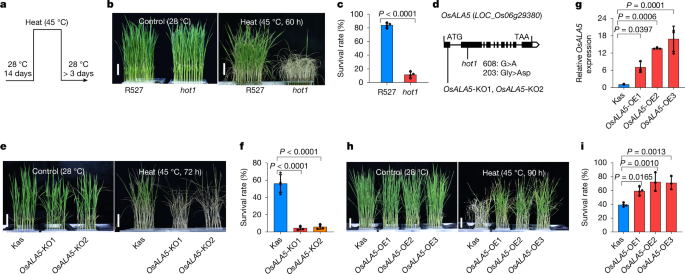
Plant materials and growth conditions The hot1 mutant was isolated from an ethyl methanesulfonate-mutagenized M 2 population of the indica cultivar Shuihui527 (R527). …
Plant materials and growth conditions The hot1 mutant was isolated from an ethyl methanesulfonate-mutagenized M 2 population of the indica cultivar Shuihui527 (R527). Approximately 3,000 M 1 plants were grown in the paddy field, and one M 2 family exhibiting an obviously reduced seed setting rate was identified during the 2017 summer season in Wenjiang, Chengdu, when field temperatures at the heading stage frequently exceeded 35 °C. Heat tolerance assay at the seedling stage (14-day-old plants, 45 °C for 60 h followed by at least 3 days of recovery) confirmed the heat-sensitive phenotype, and the mutant was designated hot1 . For subsequent gene mapping, an F 2 population was generated by crossing hot1 with R527. For functional analyses of OsALA5 , several transgenic lines were generated in different genetic backgrounds. A complementation line ( OsALA5 -C) was produced by introducing the OsALA5 genomic sequence driven by its native 2-kb promoter region into the hot1 mutant background. In the O. sativa cv. Kasalath (Kas) genetic background, two independent knockout lines ( OsALA5 -KO1 and OsALA5 -KO2) were generated using a CRISPR–Cas9 system, and the overexpression lines ( OsALA5 -OE) were obtained by expressing OsALA5 driven by the CaMV 35S promoter. Additionally, a complementation line (CL) carrying a native promoter-driven OsALA5–GFP fusion construct was created in the OsALA5 -KO1 background for subcellular localization and a series of subsequent physiological analyses. …
Original source: Nature News