Daily briefing: Ovaries start a second job after menopause
Nature News ·
You have full access to this article via your institution. Hello Nature readers, would you like to get this Briefing in your inbox free every day? Sign up here . …
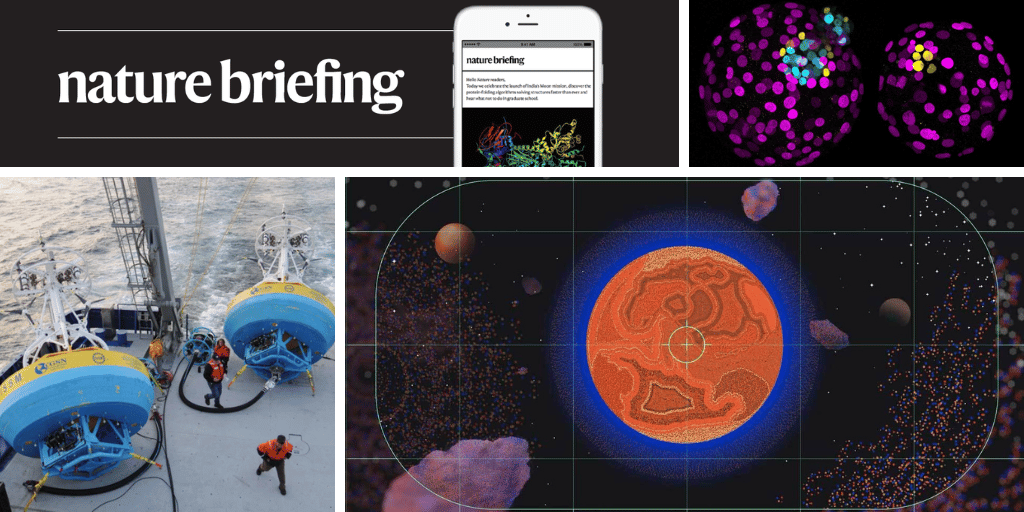
You have full access to this article via your institution. Hello Nature readers, would you like to get this Briefing in your inbox free every day? Sign up here . A human embryo ‘base edited’ so that it can’t produce a key protein (right), fails to form the mass of cells that gives rise to tissues and organs. A non-edited embryo (left) shows the cells (cyan). Credit: Katarina Harasimov, Oliver Bower and Kathy Niakan, Loke Centre for Trophoblast Research, Univ. Cambridge For the second time this month, researchers have used base editing — a precise gene-editing technique — to alter the DNA of human embryos. The team found that a key protein called NANOG plays a part in embryo development that had not been seen in mouse studies . The finding highlights the need to study human embryos rather than relying on animal models, says developmental biologist Janet Rossant. But it has also renewed the urgency of ethical discussion over how base editing of embryos should be used. Nature | 5 min read Reference: Nature paper The United States has historically led other nations in peppering the ocean with monitoring instruments and supporting cutting-edge oceanography research. Now cuts and threats of cuts have researchers worried it is no longer a reliable partner. The US National Science Foundation (NSF) has pulled back from a plan to dismantle an array of hundreds of marine instruments known as the Ocean Observatories Initiative. …
Original source: Nature News