Planet orbits so close to its star that their magnetic fields connect
Ars Technica ·
The second issue was that in some observations, there were no periodic signals at all. Because we have enough archival observation data, however, the researchers were able to track when the signal …
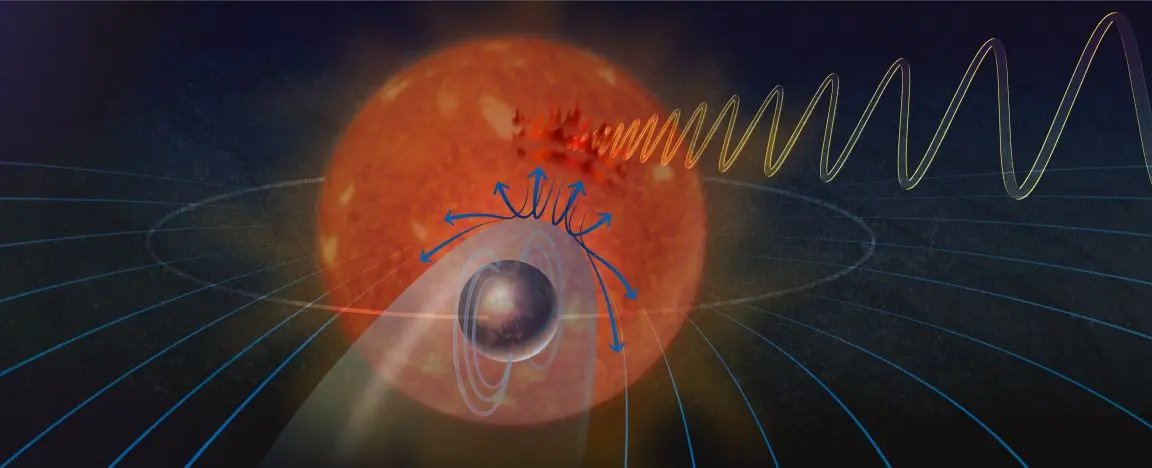
The second issue was that in some observations, there were no periodic signals at all. Because we have enough archival observation data, however, the researchers were able to track when the signal appeared and disappeared. And they were able to find a periodicity to that—one that lined up precisely with the star’s cyclic activity. (Think of our Sun’s solar cycle, and apply that to a different star.) The researchers suspect that, during high solar activity, the signal from the planet’s magnetic influence is swamped. At low periods in the cycle, the researchers suspect that there simply isn’t enough activity there for the magnetic interactions to enhance. So, they think that we see the enhanced chromosphere emissions only at intermediate levels of stellar activity. How is the magnetic influence showing up on the star in the first place? The researchers consider a number of theoretical models, but the only one that produces enough energy at the chromosphere is one where loops of magnetic field connect the fields of the planet and the star. This model allows them to estimate the strength of the planet’s magnetic field, which they put at a minimum of 6 Gauss, over 10 times the strength of Earth’s. While that all may seem a bit extreme, it’s not especially unusual, even in our Solar System. The magnetic field strength is similar to that of Jupiter, and Neptune’s magnetosphere extends out to far greater distances than the gap between GJ 436 and its planet. …
Original source: Ars Technica