James Webb Space Telescope catches 6 galaxies merging into one of the largest galaxies in the universe
Space.com ·
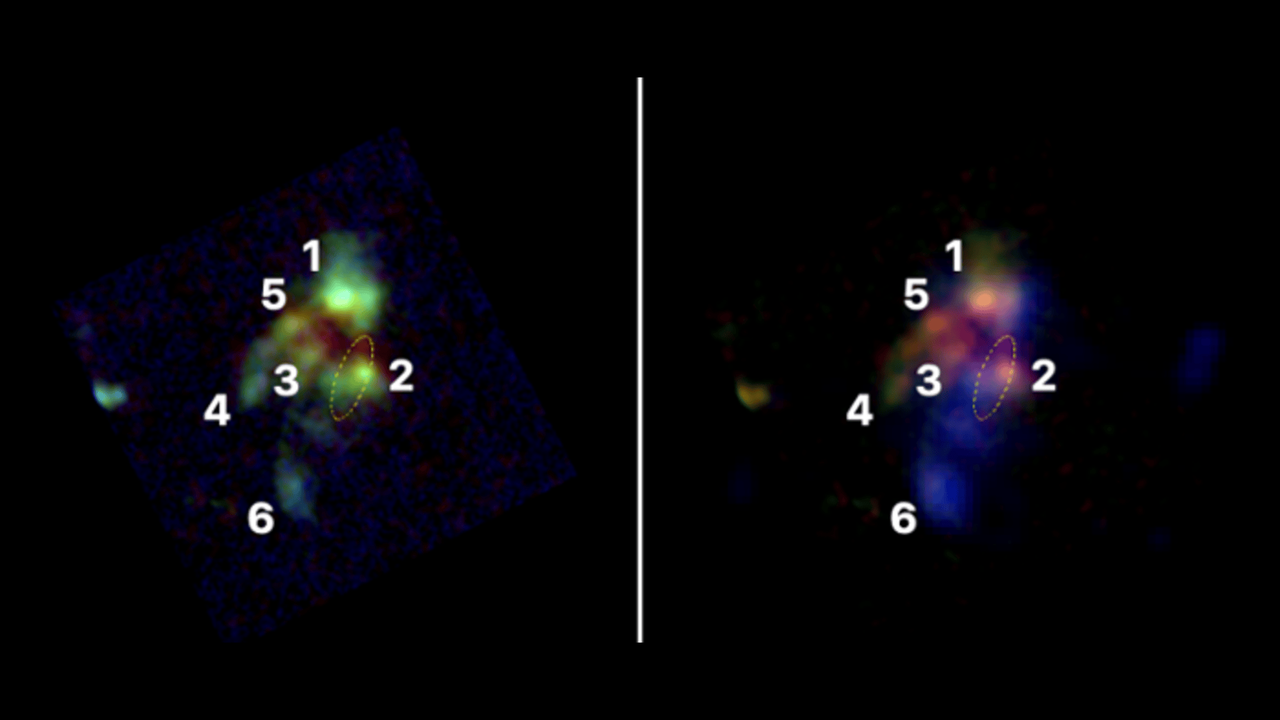
An intense demolition derby of at least six galaxies smashing into one another has been found lurking in the early universe by the James Webb Space Telescope. …
An intense demolition derby of at least six galaxies smashing into one another has been found lurking in the early universe by the James Webb Space Telescope. This merger is also expected to fuel the growth of a supermassive black hole and trigger the formation of what will eventually become one of the most massive galaxies in the cosmos. "What makes this special is that we can follow both the build-up of a giant galaxy and the growth of the black hole at its center," Huub Röttgering, an astronomer at the Netherlands' Leiden Observatory, said in a statement . The discovery came after a tip-off from radio astronomers who had noticed emissions that seemed to be coming from an undiscovered active black hole. When the James Webb Space Telescope (JWST) looked closer, it found a surprise. "We didn't find a single galaxy, but an entire complex of at least six galaxies," said Aayush Saxena of the University of Oxford. These six galaxies sit at a redshift of 4.0, which equates to a time about 12 billion years ago, just 1.8 billion years after the Big Bang . Through the vision of the JWST 's Near-Infrared Camera the six galaxies appear fuzzy, reminiscent of a faraway version of Stephan's Quintet , which is a collection of five galaxies, four of which form a compact group that are on course to merge to become a giant elliptical galaxy. …
Original source: Space.com