‘Edited’ human embryos reveal secrets of our development — and fuel ethical debate
Nature News ·
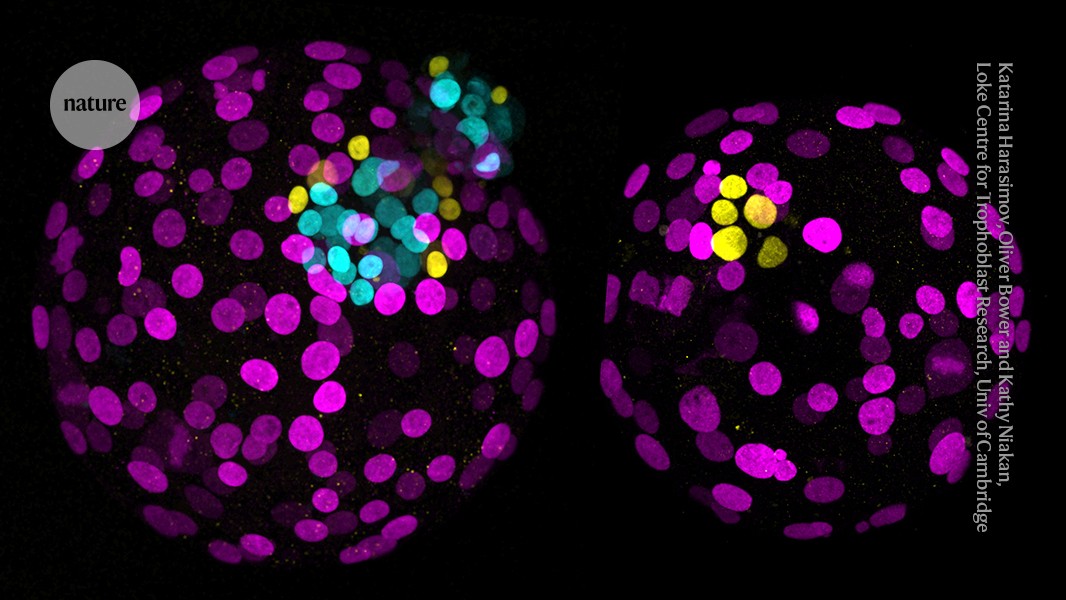
A human embryo ‘base edited’ so that it can’t produce a key protein (right), fails to form the mass of cells that gives rise to tissues and organs. A non-edited embryo (left) shows the cells (cyan). …
A human embryo ‘base edited’ so that it can’t produce a key protein (right), fails to form the mass of cells that gives rise to tissues and organs. A non-edited embryo (left) shows the cells (cyan). Credit: Katarina Harasimov, Oliver Bower and Kathy Niakan, Loke Centre for Trophoblast Research, University of Cambridge For the second time this month , a team of researchers has reported harnessing a precise gene-editing technique to alter the DNA of human embryos. Precise genome editing of human embryos triggers praise and alarm This time, the scientists used the method, called base editing , to study human development rather than to explore ways to prevent disease. However, the experiment’s success makes the need for ethical discussions around embryo editing even more urgent, some researchers say. The results, published today in Nature 1 , show that a key protein called NANOG plays a part in embryo development that had not been seen in studies in mice. That finding highlights the importance of studying human embryos, rather than relying on animal models, says Janet Rossant, a developmental biologist at the Hospital for Sick Children in Toronto, Canada. “If you want to be able to improve reproductive technologies, then it is very important to have an understanding of the normal development of the embryo,” she says. …
Original source: Nature News
Mentioned
Canada · Toronto · Canterbury