Fourier pixels for bidirectional light control
Nature News ·
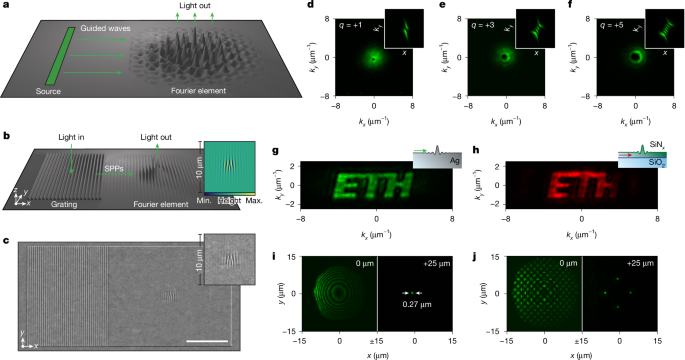
Fourier-pixel design Each Fourier pixel involves the generation, propagation and diffraction of guided waves (Fig. 1a ). Although we focus here on SPPs, the design principles also apply to photonic …
Fourier-pixel design Each Fourier pixel involves the generation, propagation and diffraction of guided waves (Fig. 1a ). Although we focus here on SPPs, the design principles also apply to photonic waveguide modes. In our plasmonic Fourier pixels, we used sinusoidal gratings to generate SPPs. The SPPs were launched when the SPP wavevector, \({k}_{{\rm{SPP}}}\) , satisfied (Extended Data Fig. 1 ) $${k}_{{\rm{SPP}}}={k}_{\parallel }+n{g}_{{\rm{m}}}$$ (1) where \({k}_{\parallel }\) is the in-plane wavevector of photons incident on the grating, \({g}_{{\rm{m}}}=2{\rm{\pi }}/\varLambda \) is the grating momentum, \(\varLambda \) is the grating period and \(n\) is the diffraction order. The photons have wavevector \({\bf{k}}\) with \(|{\bf{k}}|=k=\frac{2{\rm{\pi }}}{\lambda }\) with wavelength \(\lambda \) . If the grating contains multiple spatial frequencies, it can couple photons of different wavelengths simultaneously at the same incident angle, launching SPPs with different \({k}_{{\rm{SPP}}}\) . In a Fourier pixel, the generated SPPs propagate in \(x\) across the \(x,y\) interfacial plane with transverse-magnetic polarization. We treat the SPPs as scalar reference waves of the form $$r(x,y)={{\rm{e}}}^{{\rm{i}}{k}_{{\rm{SPP}}}x}$$ (2) The SPPs then encounter the Fourier element that creates a desired complex-valued optical wavefront \(g(x,y)\) at a specific output plane through diffraction. …
Original source: Nature News