Disparate privacy risks from medical AI
Nature News ·
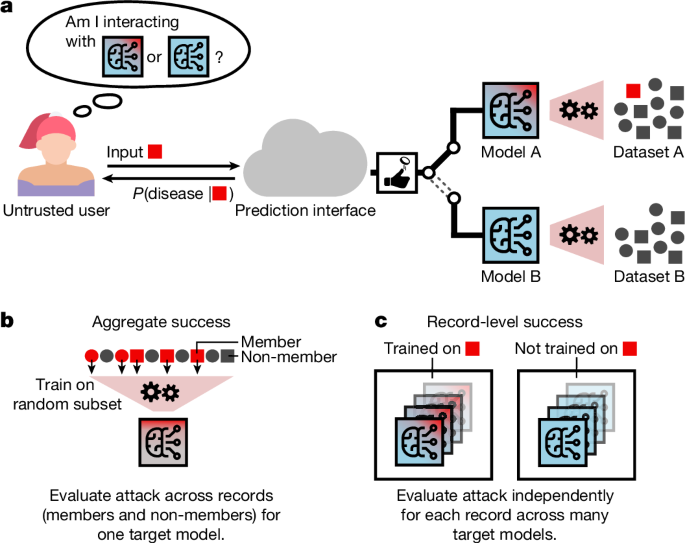
Medical artificial intelligence (AI) has immense potential to improve health outcomes, particularly in regions in which specialized medical expertise is scarce 1 . …
Medical artificial intelligence (AI) has immense potential to improve health outcomes, particularly in regions in which specialized medical expertise is scarce 1 . At the same time, AI also poses new challenges and risks, including security vulnerabilities that arise when models are deployed. Untrusted users with access to an AI model may, by merely observing its predictions, steal its parameters 8 , 9 or perform privacy attacks 2 , 3 , 4 , 5 , 6 , 7 , which can extract sensitive details about the data used for model training. Privacy attacks against an AI model can enable detailed inferences about the individuals who contributed to its training data. For example, a membership inference attack (MIA) 2 attempts to determine whether the data of a specific patient were included in the training dataset of a model. The extent to which this constitutes a privacy violation is nuanced and depends on factors such as the underlying training population and the deployment context of the model. Although inferring membership for a model trained on a general population may be benign, doing so for a model trained on a narrow, disease- or centre-specific cohort acts as a direct proxy for sensitive medical information. For example, a successful MIA against the model in ref. 10 , which predicts anti-cancer immunotherapy efficacy from routine blood test data, reveals that an individual has cancer. …
Original source: Nature News