Hubble Space Telescope images galaxy scientists thought was impossible to find
Space.com ·
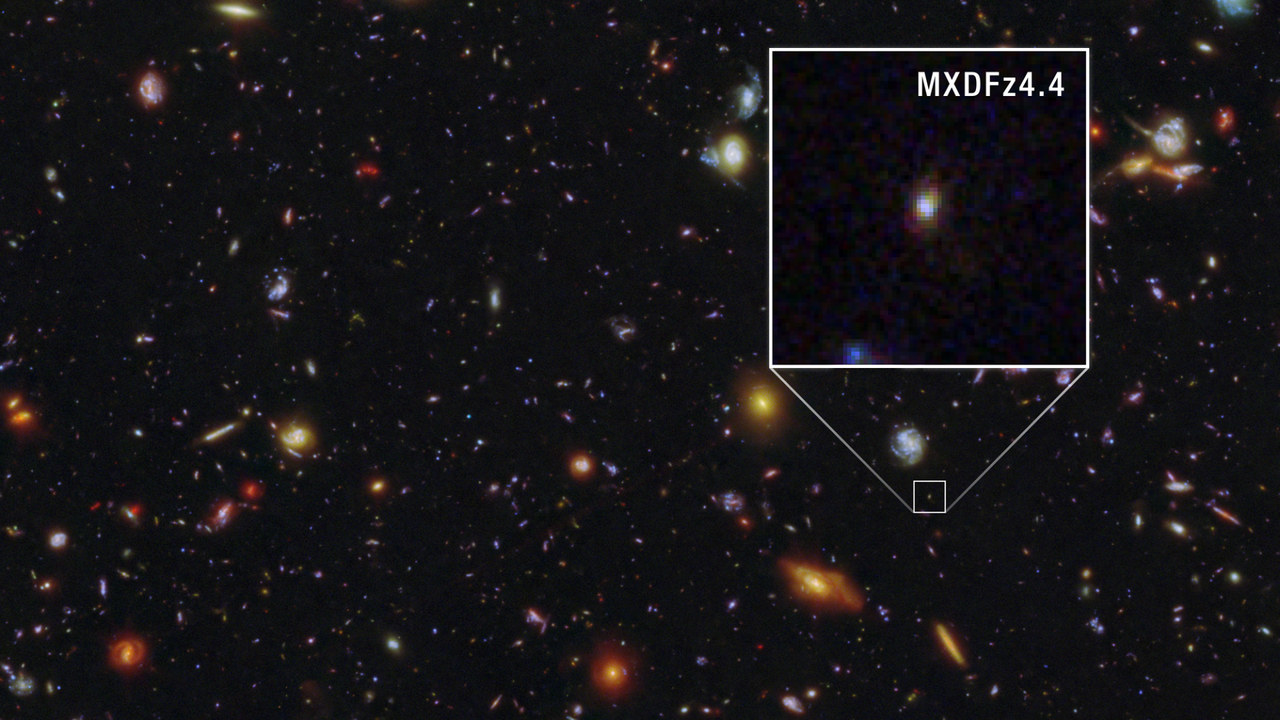
A bright, dense cluster of hot, massive stars in a galaxy that existed 1.4 billion years after the big bang has been found helping to end the early universe's foggy days during which neutral hydrogen …
A bright, dense cluster of hot, massive stars in a galaxy that existed 1.4 billion years after the big bang has been found helping to end the early universe's foggy days during which neutral hydrogen gas was draped across the cosmos, obscuring ultraviolet light from luminous objects. The cluster was found emitting ultraviolet light in a small but quickly growing galaxy by the Hubble Space Telescope . The presence of this ultraviolet light, and the star -forming history of the cluster producing it, suggests that bursts of star formation contributed to waves of ionizing radiation that gradually cleared out the opaque neutral hydrogen. In the aftermath of the big bang , the universe was filled with neutral hydrogen gas that is opaque at short wavelengths of light, such as ultraviolet. However, this ultraviolet light was the neutral hydrogen's worst enemy, gradually ionizing the gas across the universe. Once ionized, hydrogen gas cannot absorb ultraviolet light — and so, the cosmos became transparent at those wavelengths. Because of this, the first billion or so years are called the Epoch of Reionization. It is referred to as "reionization" rather than ionization because, technically, the gas had already been ionized once before during the first 379,000 years after the Big Bang. While investigating what brought about this epoch, astronomers had identified two chief suspects that could have produced sufficient amounts of ultraviolet light to ionize the neutral hydrogen. …
Original source: Space.com
Mentioned
Big Bang · supernova · Baltimore · James Webb Space Telescope