Making samples one billion times bigger lets simple microscopes pinpoint amino acids
Nature News ·
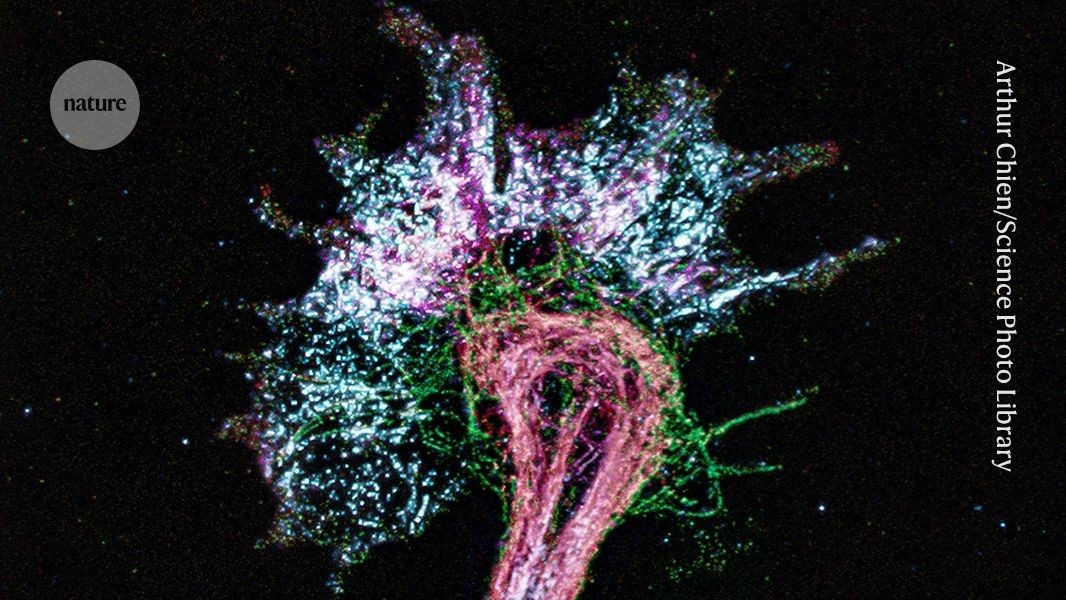
High-resolution images can be produced by increasing the size of a nerve cell before fluorescence-microscopy imaging. Credit: Arthur Chien/SPL A technique that supersizes cells to reveal minute …
High-resolution images can be produced by increasing the size of a nerve cell before fluorescence-microscopy imaging. Credit: Arthur Chien/SPL A technique that supersizes cells to reveal minute details has gone big — really big. Using a polymer like those used in nappies to make them super-absorbent, scientists have expanded the volume of biological samples so they are one billion times bigger — 1,000-fold larger in each dimension. This level of expansion could inflate an individual cell to the size of a mouse brain and a US dime-size sample to the proportion of an Olympic swimming pool. Researchers have used the technique to map the positions of amino acids (the building blocks of proteins) within proteins and small molecules called peptides using conventional light microscopes. The approach is outlined in a preprint posted on bioRxiv earlier this month 1 . Previously, viewing molecules in such fine detail has typically been achieved by using costly and complicated techniques such as cryogenic electron microscopy (cryo-EM) and X-ray crystallography. “This is the democratization of structural biology,” says study co-author Silvio Rizzoli, a neuroscientist and imaging specialist at the University Medical Center Göttingen (UMG) in Germany. “It’s really getting down to a ground-truth description of what a protein is,” adds co-author Helena Hu, a bioengineer at the Massachusetts Institute of Technology (MIT) in Cambridge. …
Original source: Nature News