Hubble Details Early Galaxy Transforming Neighborhood
NASA Breaking News ·
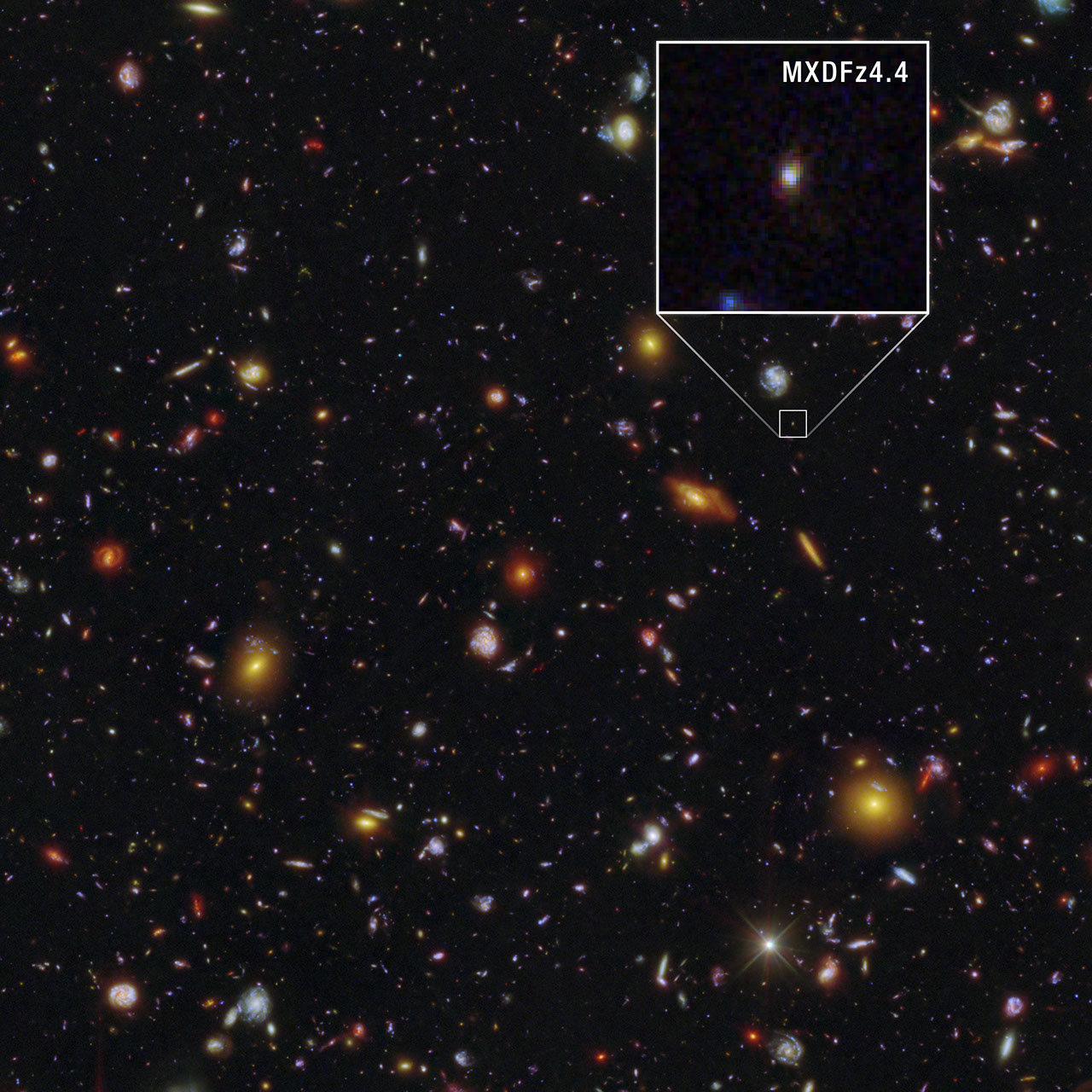
Astronomers using NASA’s Hubble Space Telescope have found something they never expected — ultraviolet light from a galaxy that existed just 1.4 billion years after the big bang. …
Astronomers using NASA’s Hubble Space Telescope have found something they never expected — ultraviolet light from a galaxy that existed just 1.4 billion years after the big bang. That galaxy contains tightly clustered young stars that produce ionizing light capable of transforming the opaque, neutral gas within and immediately around the galaxy, clearing our view. This suggests that similar galaxies in the early universe were responsible for clearing the neutral fog of hydrogen gas that once filled the cosmos. A paper describing this discovery was published June 23 in the Astrophysical Journal. The galaxy, cataloged MXDFz4.4, existed at the end of the Era of Reionization , a transformative period in our universe. During roughly the first billion years of the cosmos, the gas between stars and galaxies was opaque to energetic ultraviolet light. As time wore on, gas everywhere became transparent or ionized. The changeover was not like an on/off switch, but likely took hundreds of millions of years. Researchers are still collecting evidence to fully understand how this happened, which is why MXDFz4.4 sets a critical precedent. “Observing a galaxy like this was thought to be impossible,” said lead author Ilias Goovaerts, a postdoctoral fellow at the Space Telescope Science Institute (STScI) in Baltimore. “Researchers expected the ‘fog’ or neutral hydrogen that filled the early universe would be too thick and obscure our view of its ionizing light. …
Original source: NASA Breaking News
Mentioned
Baltimore · Astrophysical Journal · Hubble Space Telescope · James Webb Space Telescope