This ball of stars named Terzan 5 may be one of the Milky Way's original building blocks
Space.com ·
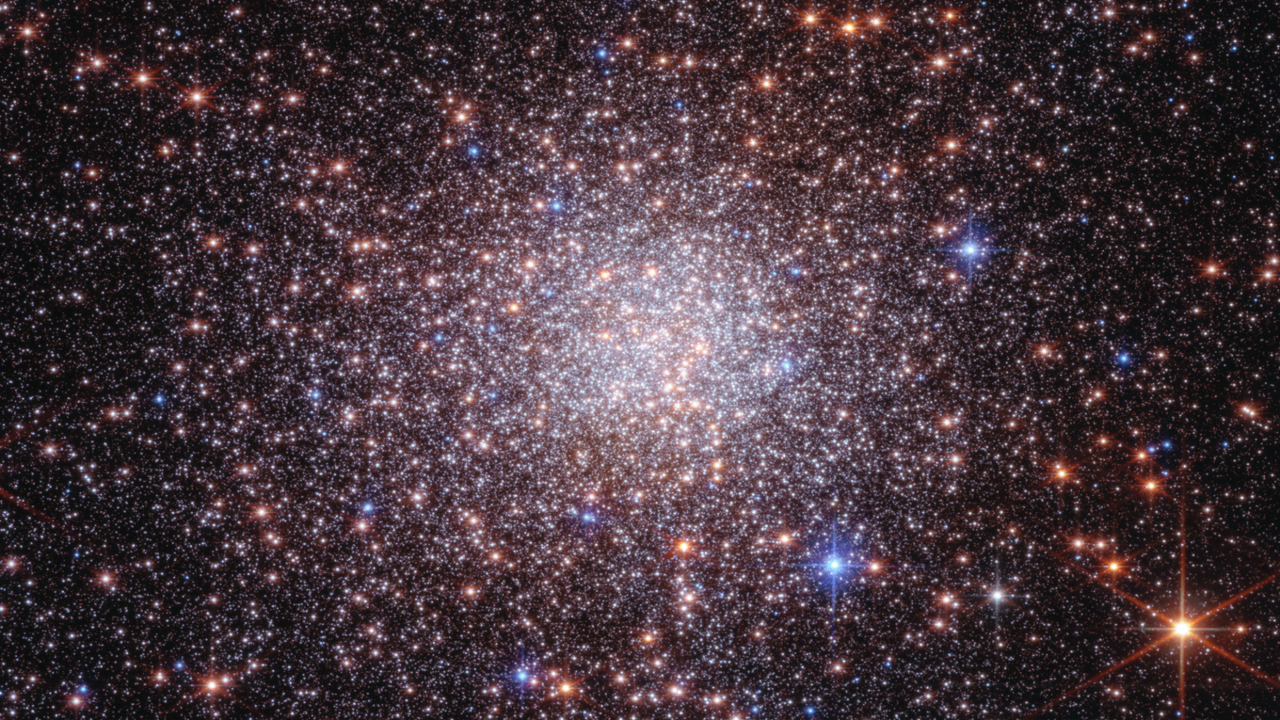
A huge, shining bauble of stars called Terzan 5 could be a clump of our galaxy's central bulge that hasn't been smoothed out into the mix, and has instead survived as a fossil relic leftover from the …
A huge, shining bauble of stars called Terzan 5 could be a clump of our galaxy's central bulge that hasn't been smoothed out into the mix, and has instead survived as a fossil relic leftover from the birth of the Milky Way galaxy. "Terzan 5 may provide direct evidence that can help explain how bulges formed in galaxies throughout the universe," said Barbara Lanzoni of the University of Bologna in a statement . Lanzoni is a member of a team of astronomers, led by Bologna colleagues Giorgia Zullo and Francesco Ferraro, who tackled Terzan 5 with the James Webb Space Telescope (JWST). Terzan 5 is a globular cluster — a huge sphere of stars with a total mass two million times greater than our sun's and a total luminosity 800,000 times greater. The problem is, Terzan 5 lies about 18,800 light-years away in the bulge of the Milky Way galaxy . This means dense lanes of intervening galactic dust block our view, significantly dimming Terzan 5's apparent brightness. That's why it wasn't discovered until 1968 by the Turkish–French–Armenian astronomer Agop Terzan. Globular clusters tend to be ancient. They also tend to have formed all their stars in one giant burst. As such, all their stars should be the same age, 12 to 13 billion years old. Yet, a select few globular clusters show evidence of having more than one generation of stars. …
Original source: Space.com
Mentioned
California · Northrop Grumman · Hubble Space Telescope · James Webb Space Telescope