Towers once planned for California shuttle launches leveled for SpaceX rockets
Ars Technica ·
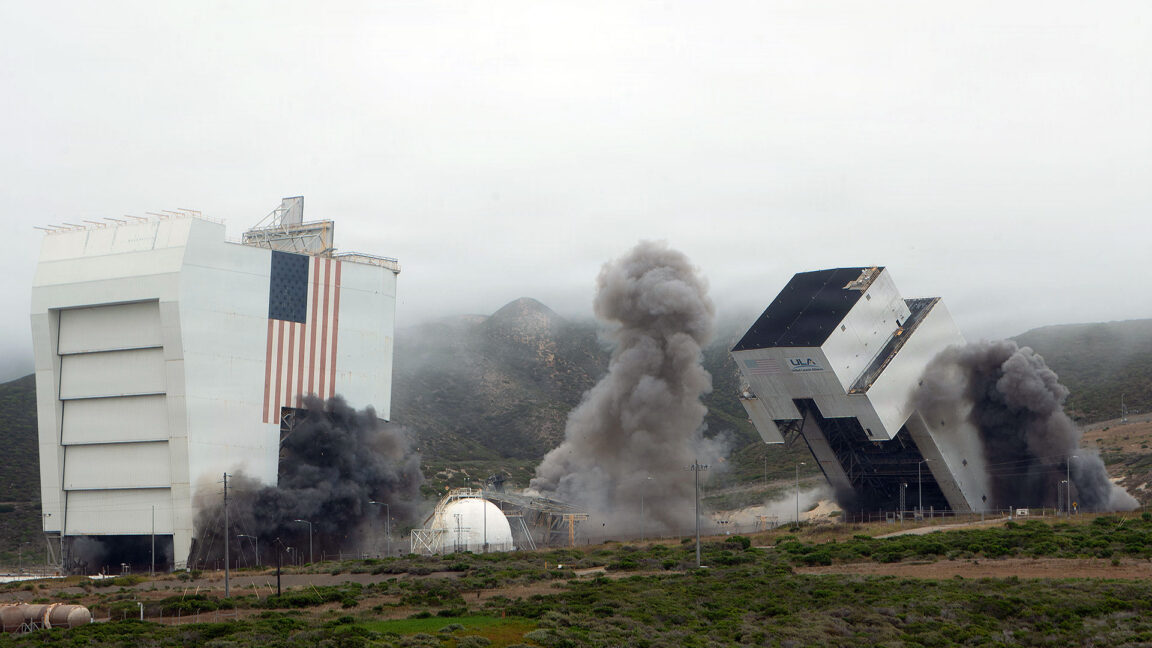
In the end, only the prototype Enterprise was stood up with an external tank and solid rocket boosters on SLC-6 before the Challenger tragedy in 1986 caused the DOD to rethink its reliance on the …
In the end, only the prototype Enterprise was stood up with an external tank and solid rocket boosters on SLC-6 before the Challenger tragedy in 1986 caused the DOD to rethink its reliance on the shuttle. Again, the Air Force walked away from the built-up facility, having never launched a single mission. NASA’s prototype space shuttle orbiter Enterprise, stacked with an external tank and two solid rocket boosters, stands at Space Launch Complex-6 (SLC-6), flanked by the assembly building and mobile service tower at Vandenberg Air Force Base (today Vandenberg Space Force Base) in California in February 1985. Credit:
U.S. Air Force/Tech. Sgt. James Pearson NASA’s prototype space shuttle orbiter Enterprise, stacked with an external tank and two solid rocket boosters, stands at Space Launch Complex-6 (SLC-6), flanked by the assembly building and mobile service tower at Vandenberg Air Force Base (today Vandenberg Space Force Base) in California in February 1985. Credit:
U.S. Air Force/Tech. Sgt. James Pearson After a brief effort to revive SLC-6 for use with the Titan IV in the early 1990s, the site finally saw its first operational use with the launch of Lockheed Martin’s LMLV-1 in 1995, followed by Athena I and Athena II rockets with payloads for NASA and Space Imaging (later GlobalEye) in 1997 and 1999, respectively. …
Original source: Ars Technica