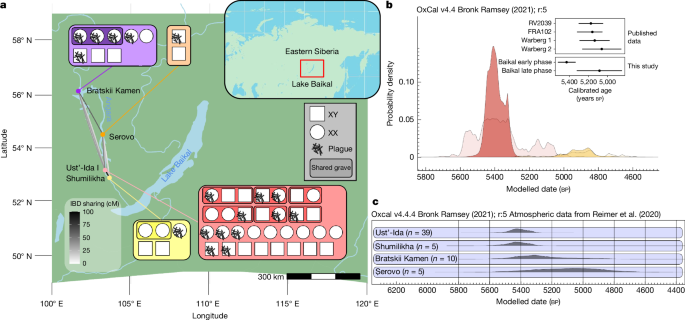
Lethal plague outbreaks in Lake Baikal hunter-gatherers 5,500 years ago
Nature News ·
Barbieri, R. et al. Yersinia pestis : the natural history of plague. Clin. Microbiol. Rev. https://doi.org/10.1128/cmr.00044-19 (2020). Article PubMed PubMed Central Google Scholar Spyrou, M. A. …
Barbieri, R. et al. Yersinia pestis : the natural history of plague. Clin. Microbiol. Rev. https://doi.org/10.1128/cmr.00044-19 (2020). Article PubMed PubMed Central Google Scholar Spyrou, M. A. et al. Analysis of 3800-year-old Yersinia pestis genomes suggests Bronze Age origin for bubonic plague. Nat. Commun. 9 , 2234 (2018). Article ADS PubMed PubMed Central Google Scholar Andrades Valtueña, A. et al. Stone Age Yersinia pestis genomes shed light on the early evolution, diversity, and ecology of plague. Proc. Natl Acad. Sci. USA 119 , e2116722119 (2022). Article PubMed PubMed Central Google Scholar Key, F. M. et al. Emergence of human-adapted Salmonella enterica is linked to the Neolithization process. Nat. Ecol. Evol. 4 , 324–333 (2020). Article PubMed PubMed Central Google Scholar Mühlemann, B. et al. Ancient hepatitis B viruses from the Bronze Age to the Medieval period. Nature 557 , 418–423 (2018). Article ADS PubMed Google Scholar Harbeck, M. et al. Yersinia pestis DNA from skeletal remains from the 6th century AD reveals insights into Justinianic Plague. PLoS Pathog. 9 , e1003349 (2013). Article PubMed PubMed Central Google Scholar Spyrou, M. A. et al. The source of the Black Death in fourteenth-century central Eurasia. Nature 606 , 718–724 (2022). Article ADS PubMed PubMed Central Google Scholar Rasmussen, S. et al. Early divergent strains of Yersinia pestis in Eurasia 5,000 years ago. Cell 163 , 571–582 (2015). …
Original source: Nature News