Confined migration induces non-lethal DNA damage in developing neurons
Nature News ·
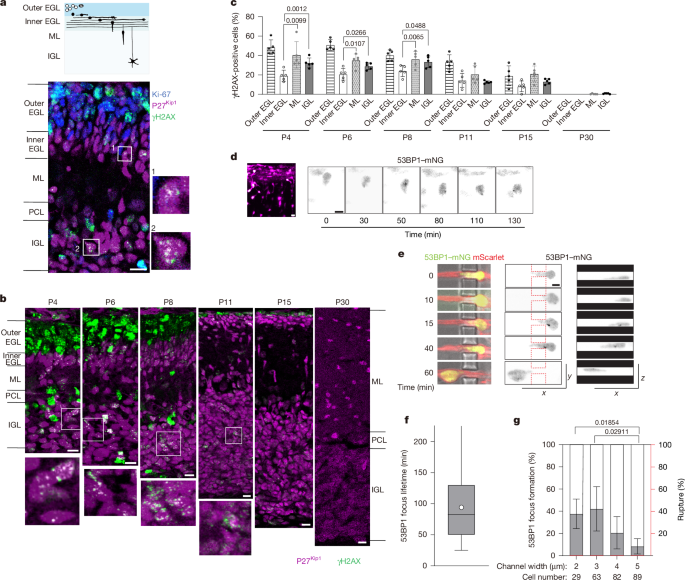
Lists of the antibodies and reagents used are provided in Supplementary Tables 1 and 2 . Plasmids The pCAG-mScarlet plasmid was generated using the mScarlet sequence obtained from Addgene (85042; a …
Lists of the antibodies and reagents used are provided in Supplementary Tables 1 and 2 . Plasmids The pCAG-mScarlet plasmid was generated using the mScarlet sequence obtained from Addgene (85042; a gift from D. Gadella). To generate the pCAG-53BP1-mNeonGreen construct, mouse 53BP1 cDNA was amplified from a mouse brain cDNA library and inserted into the pENTR1A vector. In parallel, the Gateway cassette from pDest-eGFP-N1 was inserted into the EcoRI site of pmNeonGreen using In-Fusion Cloning to generate pDest-mNeonGreen. The 53BP1 cDNA in pENTR1A was recombined into pCAG-Dest-mNeonGreen using LR Clonase II Enzyme Mix (Invitrogen, 11791020) to produce the final pCAG-53BP1-mNeonGreen construct. The pTRIP-CMV-GFP-Flag-cGAS plasmid was obtained from Addgene (86674; a gift from N. Manel). mCherry-KASH1 was constructed as previously decribed 13 . The pAAV-Neurod1-GFP plasmid was constructed by replacing the CAG promoter in pAAV-CAG-EGFP 51 with the Neurod1 promoter, which was cloned from the cDNA of CGNs isolated from P6 ICR mice. Animals All animal experiments were approved by the Animal Experiment Committee of Kyoto University (KUIAS 1-9) and conducted in accordance with the guidelines of the National Centre for the Replacement, Refinement and Reduction of Animals in Research. For some in vitro experiments, timed-pregnant C57BL/6J and ICR mice were purchased from Japan SLC. …
Original source: Nature News