A 98-qubit trapped-ion quantum computer with all-to-all connectivity
Nature News ·
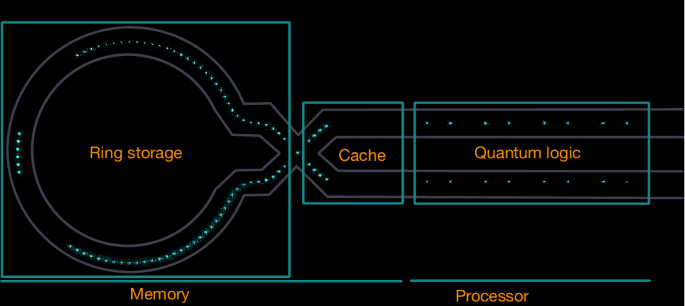
Quantum operations The 1Q and 2Q gates are implemented with pairs of 515-nm laser beams separated by the approximately 8.04 GHz qubit frequency splitting. …
Quantum operations The 1Q and 2Q gates are implemented with pairs of 515-nm laser beams separated by the approximately 8.04 GHz qubit frequency splitting. The 1Q gates, \({U}_{1{\rm{Q}}}(\theta ,\phi )={{\rm{e}}}^{(-{\rm{i}}\theta /2)(\cos \phi X+\sin \phi Y)}\) , are implemented with co-propagating laser beams for improved phase stability of the Raman interaction and minimal sensitivity to the thermal motion of the ions. 1Q Z -rotations, R Z ( θ ) = e −i Z θ /2 , are implemented by phase changes in software tracking and applied to the next 1Q gate scheduled. The 2Q gates are implemented with beams intersecting the quantum logic zones at 90° to each other such that the difference k -vector is parallel to the crystal axis (Fig. 2e ). The 2Q gate protocol is based on the Mølmer–Sørensen interaction using wrapper pulses to remove optical phase sensitivity 21 , 77 , yielding a native 2Q gate R Z Z ( θ ) = e −i Z Z θ /2 . The gate angle θ is specified by the user and is varied by adjusting the detuning and duration of the gate. Gate infidelities have been shown to improve for smaller angles 22 but here we only benchmark the perfect entangler R Z Z (π/2). SPAM is achieved in 137 Ba + with a combination of lasers at 493 nm, 614 nm, 650 nm and 1,762 nm, with preparation accomplished by means of narrow-band optical pumping 9 , 78 . …
Original source: Nature News