Daily briefing: How Venus flytraps snap shut
Nature News ·
You have full access to this article via your institution. Hello Nature readers, would you like to get this Briefing in your inbox free every day? Sign up here . …
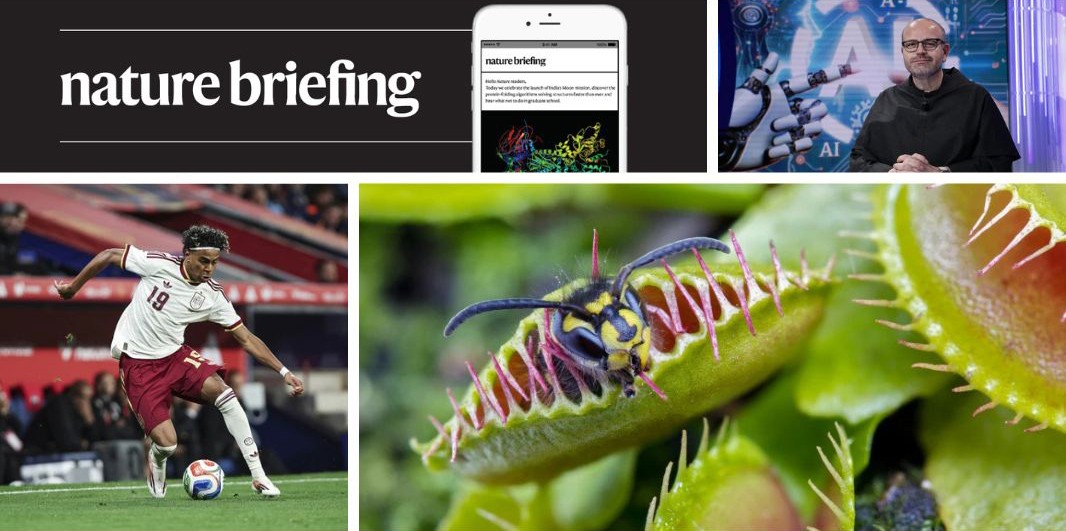
You have full access to this article via your institution. Hello Nature readers, would you like to get this Briefing in your inbox free every day? Sign up here . The lobes that form the Venus flytrap’s mouth curve inwards to trap prey. Credit: Chris Mattison/Nature Picture Library Venus flytraps ( Dionaea muscipula ) snap shut by rapidly softening cells on the outer surface of their hinged ‘mouths’ . Plants can relax the rigid outer walls of their cells to enable growth, but cell softening at the pace of flytraps is a phenomenon scientists haven’t seen before, says biomechanics researcher Simon Poppinga. Exactly what softens the cells is still unclear, but the team behind the study suggests one possibility is that the arrival of prey triggers the release of a cocktail of enzymes that weaken the walls’ structure. Nature | 5 min read Reference: Science paper The men’s football World Cup 2026 kicked off yesterday, and every team will have access to an artificial-intelligence tool that can analyse its players’ movements, and digital avatars of the players will help referees to model match action and spot illegal moves. To understand the role science will have in the beautiful game’s biggest tournament, Nature spoke to Franco Impellizzeri, the editor-in-chief of the journal Science and Medicine in Football . “Nowadays, most clubs and national teams have sport scientists,” he says. …
Original source: Nature News