James Webb Space Telescope forecasts extreme weather on exoplanet that rains rubies and sapphires
Space.com ·
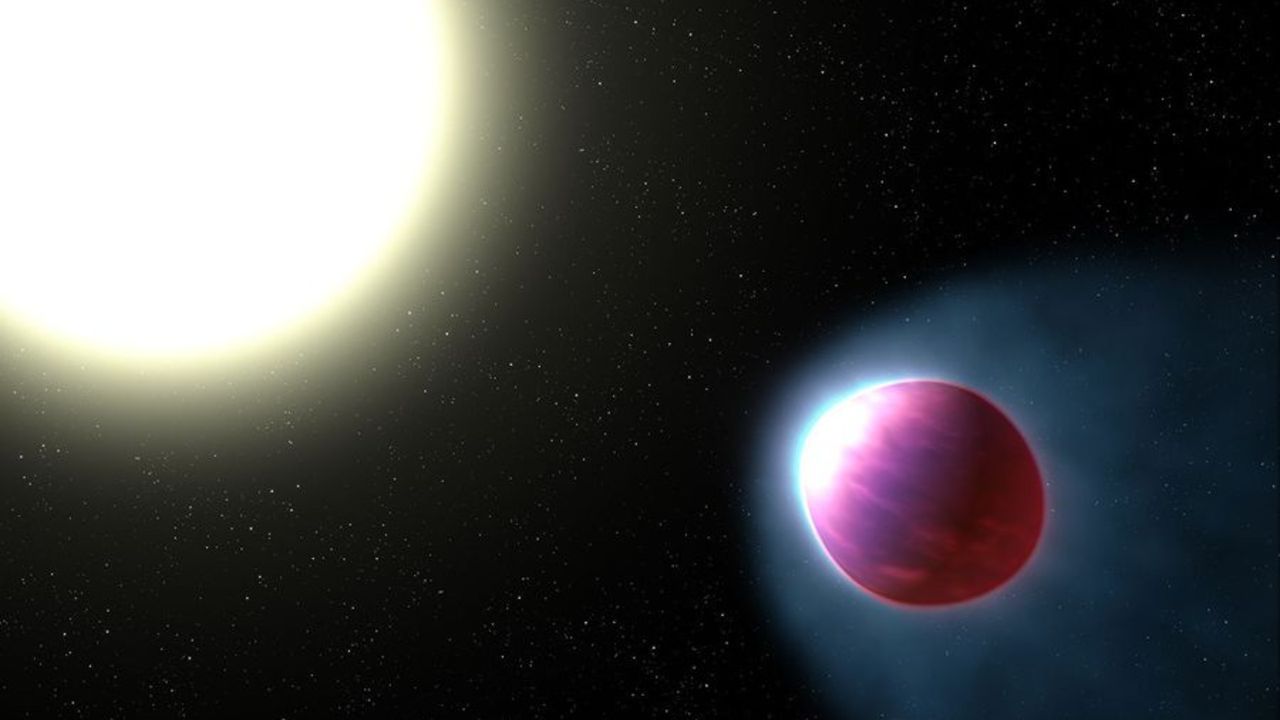
Imagine a world where the weather forecast calls for winds blowing at 11,000 miles per hour (18,000 kilometers per hour) and nighttime showers of liquid metal, rubies and sapphires. …
Imagine a world where the weather forecast calls for winds blowing at 11,000 miles per hour (18,000 kilometers per hour) and nighttime showers of liquid metal, rubies and sapphires. This is the chaotic reality astronomers have pieced together for WASP-121b, an "ultra-hot Jupiter" that ranks among the most extreme planets known beyond the solar system . The gas giant orbits its host star at such a punishingly close distance that a single "year" there lasts just 30.5 hours. At that proximity — so close that if it got any closer, stellar gravity would start ripping it apart — the host star's immense tidal forces have warped the planet from a sphere into a football-like shape. Temperatures on its dayside climb high enough to vaporize metals , while previous studies have suggested that iron may condense and fall as rain on the cooler nightside. Now, astronomers using the James Webb Space Telescope (JWST) have added another piece to the world's meteorological portrait. By tracking subtle changes in starlight passing through WASP-121 b's atmosphere as the planet crossed in front of its star, researchers detected differences between atmospheric conditions at dawn and dusk, according to the study. "With its unprecedented observational quality, JWST gives us the most detailed glimpses into distant planets to date," study lead author Cyril Gapp of the Max Planck Institute for Astronomy in Germany, said in a statement . …
Original source: Space.com
Mentioned
JWST · Chile · Germany · Jupiter · Hubble Space Telescope · James Webb Space Telescope