20 years of Intel Macs: Why Apple switched, and why it switched again
Ars Technica ·
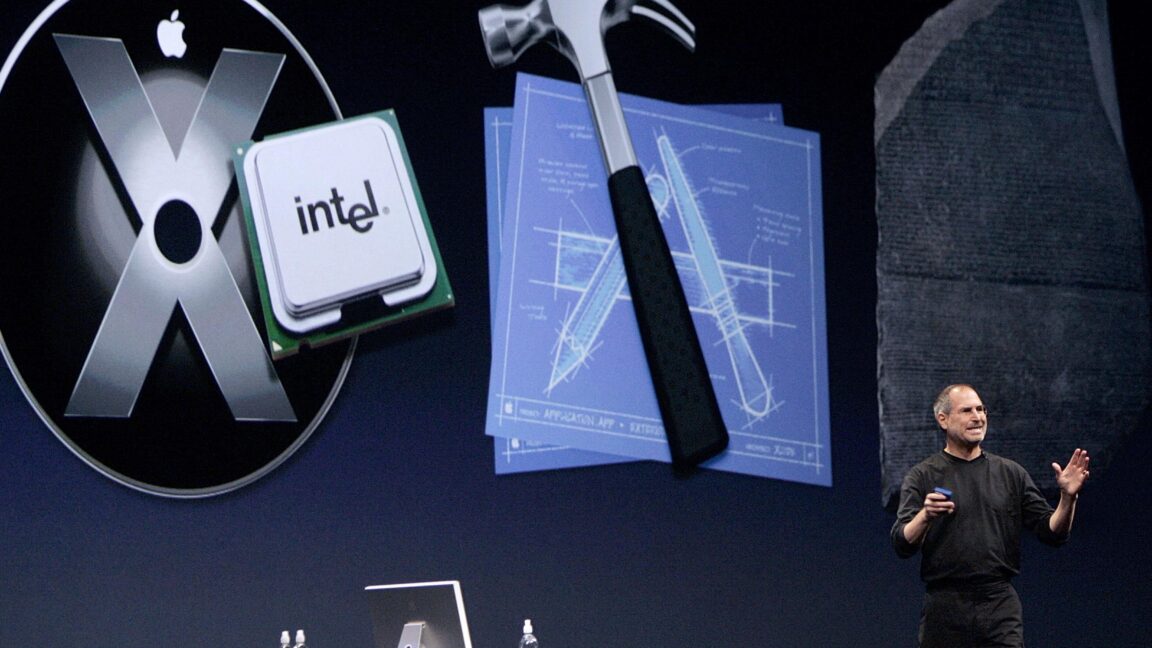
“And so today for the first time, I can confirm the rumors that every release of Mac OS X has been compiled for both PowerPC and Intel,” announced Jobs. …
“And so today for the first time, I can confirm the rumors that every release of Mac OS X has been compiled for both PowerPC and Intel,” announced Jobs. “This has been going on for the last five years. Just in case.” The transition The “first” Intel Mac was a Developer Transition Kit (DTK) made available to software developers after WWDC 2005. It was essentially a Pentium 4-based PC inside a Power Mac G5 case, and it was available strictly as a loan to developers who could pay $499 per year for a developer account and another $999 for the kit. Few, if any, of these DTK kits survived; Apple required developers to return the systems by the end of 2006 and offered to trade them for a real retail Intel Mac to seal the deal. The WWDC keynote laid out the timeline, in addition to the tools Apple would use to help developers and users navigate the transition. The next version of Mac OS X, version 10.5 Leopard, would be compatible with both PowerPC and Intel Macs. A compatibility layer called Rosetta would run most PowerPC apps tolerably well while developers worked on Intel-native versions, which could be distributed as universal binaries that supported both CPU architectures. This transition worked well enough that Apple essentially handled the Intel-to-Apple-Silicon switch the exact same way. Apple would also take advantage of the fact that its computers would use the same hardware as other PCs. …
Original source: Ars Technica