Do galaxies have a 'kill switch' that makes them stop growing?
Space.com ·
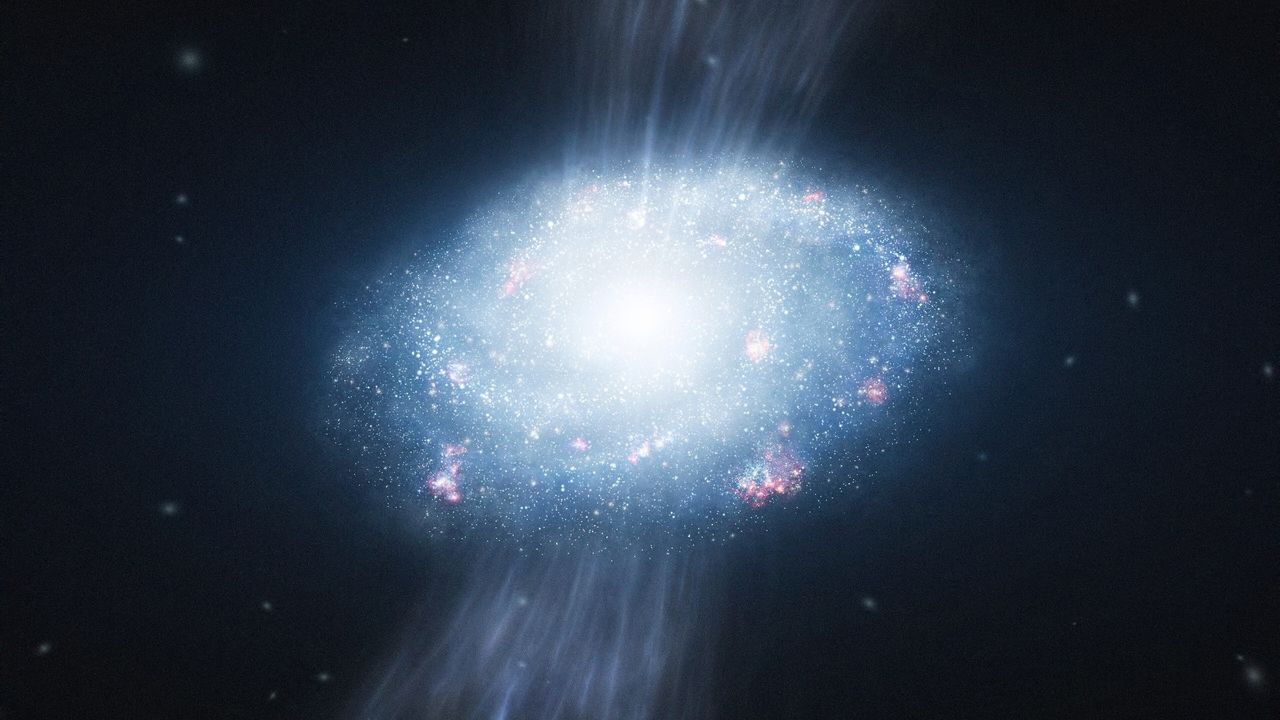
Galaxies don't grow forever. At some point, even the most prolific star-forming galaxies start to slow down, then stall, then settle into a long quiet retirement. …
Galaxies don't grow forever. At some point, even the most prolific star-forming galaxies start to slow down, then stall, then settle into a long quiet retirement. Astronomers have known about this transition for a long time, but we haven't had a clean physical explanation for why it happens, and why it happens at the particular mass scale that it does. A new paper led by Preetish Mishra of the Korea Institute for Advanced Study, along with an international team of scientists, makes a clear and testable proposal: that the slowdown in galaxy growth is caused by the birth of a stable cloud of hot gas surrounding the galaxy, and that cloud forms at a very specific mass: roughly 10^12.5 solar masses. Above that threshold, galaxies stop being efficient stellar factories, no matter how much raw material they have on hand. The question is: what flips the switch? To get to that calculation, the team used the Horizon Run 5 simulation, one of the largest cosmological simulations ever created. It takes a chunk of virtual universe roughly a gigaparsec across, models the full physics of gas, gravity, star formation, supernovas, and supermassive black holes from shortly after the Big Bang to the present day, and lets researchers track individual galaxies through their entire histories. Mishra and colleagues picked out roughly 20,000 of the most massive central galaxies and watched what happened to them over cosmic time. The key quantity they tracked is the stellar-to-total mass ratio. …
Original source: Space.com