How ice forms is a mystery — now scientists are cracking the case
Nature News ·
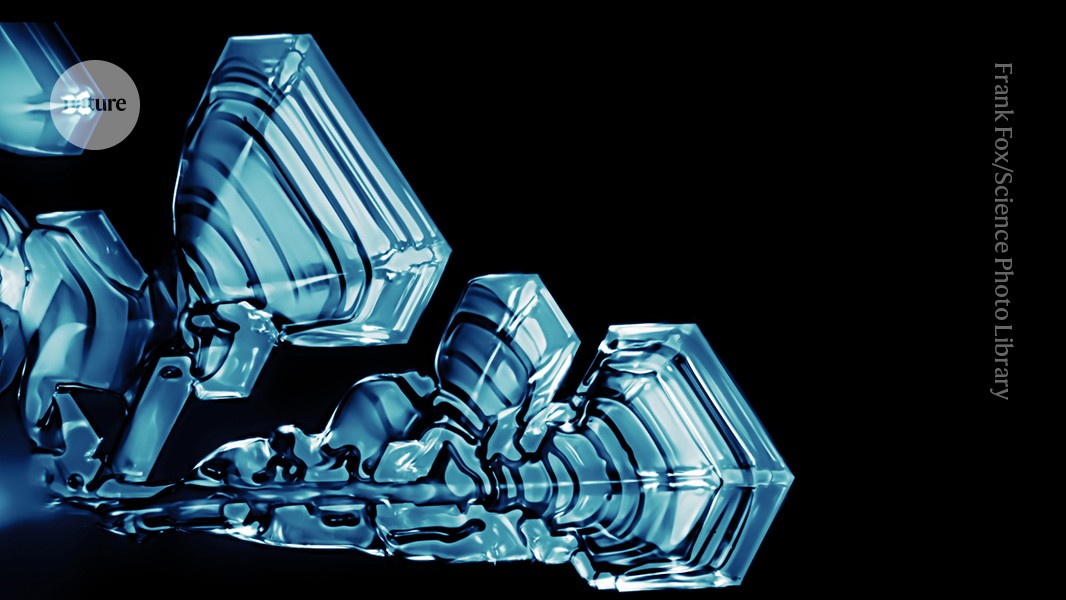
Beneath a suburb of Hamburg in Germany, an underground particle accelerator propels electrons at close to the speed of light through a slalom course of magnets. …
Beneath a suburb of Hamburg in Germany, an underground particle accelerator propels electrons at close to the speed of light through a slalom course of magnets. Racing through the twists and turns, the electrons emit bursts of radiation that produce one of the world’s most powerful X-ray laser beams. This prized machine, the European X-ray Free Electron Laser Facility (XFEL), has helped researchers to make ultrafast movies of chemical reactions and to map the atomic structures of viruses. Now, they are using it to crack the secrets of a seemingly simple process that has bedevilled scientists for decades: how water and other liquids freeze. For 150 years, theorists have been trying to explain the process that turns pure liquids into solids. But their models of how quickly this happens are often wildly inaccurate when compared with experiments — results can be off by as much as 20 orders of magnitude. Can artificially altered clouds save the Great Barrier Reef? It’s hard to resolve this problem, says theorist Michele Parrinello at the University of Italian Switzerland in Lugano, Switzerland. “Experiments are very difficult,” he says. “And theory is difficult, and computer simulations are also difficult.” Tiny errors in modelling or in experiments can lead to huge changes in outcomes. The mystery behind the freezing of liquids — including molten metals — is not just an esoteric puzzle. …
Original source: Nature News