James Webb Space Telescope weighs 'sleeping giant' black hole from 10 billion light-years away — and it's 6 billion times our sun's mass
Space.com ·
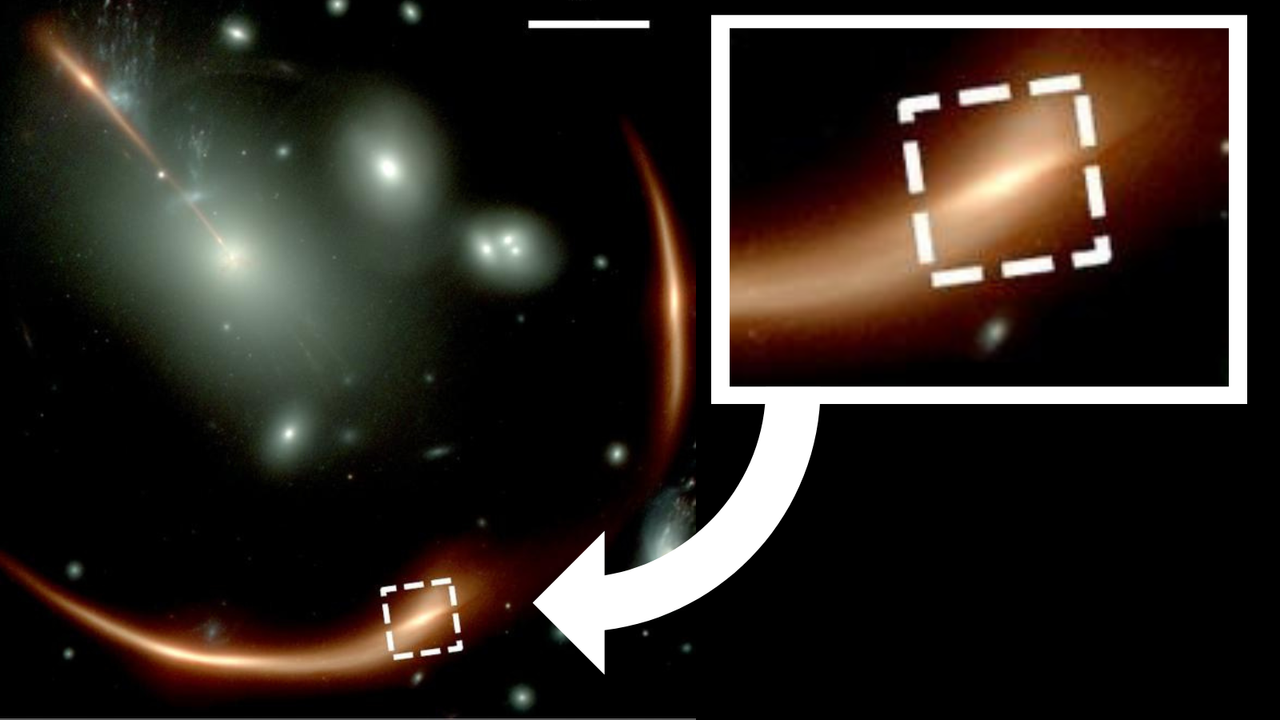
Using the James Webb Space Telescope (JWST), astronomers have "weighed" a sleeping giant — a dormant supermassive black hole located a staggering 10 billion light-years away. …
Using the James Webb Space Telescope (JWST), astronomers have "weighed" a sleeping giant — a dormant supermassive black hole located a staggering 10 billion light-years away. That makes this black hole the most distant supermassive black hole scientists have ever measured the mass of. The supermassive black hole is located at the heart of the galaxy MRG-M0138, which is seen as it was when the universe was just around 4 billion years old — and we now know, thanks to the James Webb Space Telescope (JWST), that it weighs an incredible 6 billion times the mass of the sun . Supermassive black holes can be very conspicuous when actively feeding and therefore surrounded by a wealth of matter in a region called an active galactic nuclei (AGN). Because of the black hole's immense gravitational forces, an AGN glows very brightly. However, because black holes are surrounded by a light-trapping boundary called an event horizon , dormant black holes with larders that aren't quite so well stocked are far more elusive. They're practically invisible. Still, even these black holes have gravitational influences that can impact more than the swirling platters of gas and dust — that influence can also affect the motion of stars orbiting the black holes. And those stars are indeed visible. To detect and measure the mass of this supermassive black hole, the team behind this research used the JWST to track the motion of stars at the heart of MRG-M0138. …
Original source: Space.com
Mentioned
NASA · JWST · Earth · Pasadena · California · James Webb Space Telescope