How AI is reshaping discovery in maths and physics
Nature News ·
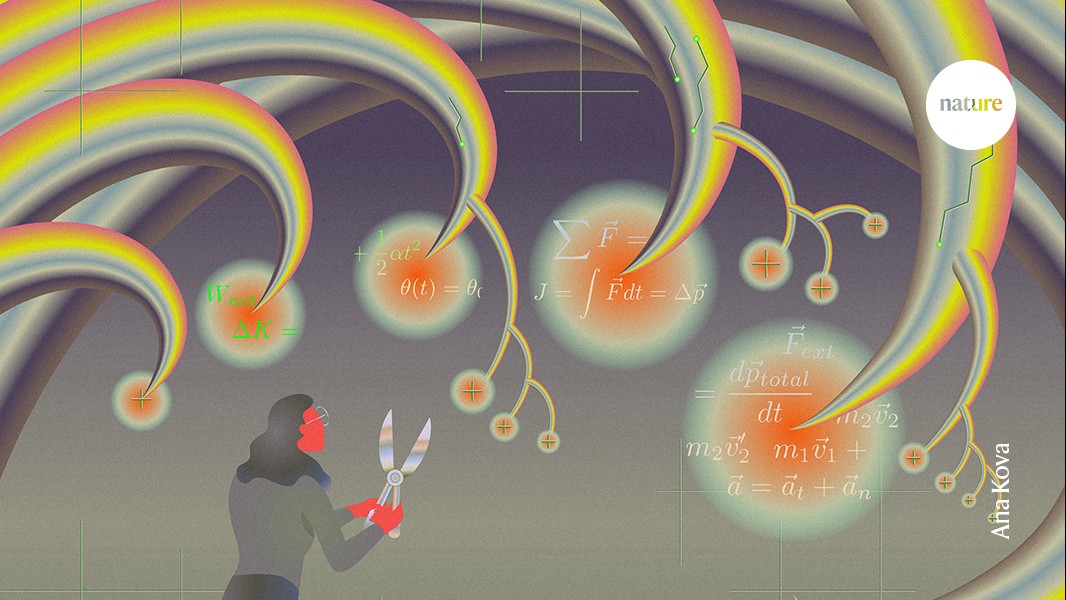
Among mathematicians and theoretical physicists, artificial intelligence provokes a range of reactions. Some see it as irrelevant to their work; others fear it could encroach on the most creative, …
Among mathematicians and theoretical physicists, artificial intelligence provokes a range of reactions. Some see it as irrelevant to their work; others fear it could encroach on the most creative, intellectually rewarding aspects of their fields. Yet, the truth that’s emerging, from the work our team is doing at the London Institute for Mathematical Sciences and elsewhere, is subtler. Rather than displacing human creativity in mathematical sciences, AI is augmenting it. Software can now check proofs line by line and catch errors that would once have taken months of human scrutiny to find. It can search systematically for counterexamples — testing whether a conjecture truly holds or fails in an unexpected way. And it can propose intermediate steps in an argument, suggesting useful auxiliary results that help to bridge the gap between what is known and what still needs to be shown. AI cracks 80-year-old mathematics challenge — researchers are astonished In experimental fields, prototype ‘AI scientists’ are beginning to automate parts of the discovery cycle, but they remain constrained by the demands of the physical world: mixing reagents, culturing cells, waiting for reactions and contending with noise in the data. Mathematics and theoretical physics face many fewer bottlenecks. ‘Experiments’ are cheap, fast and digital, and mathematical data — from prime numbers to the properties of abstract structures, such as manifolds — are clean and abundant 1 . …
Original source: Nature News
Mentioned
MAXWELL · Palo Alto · California · San Francisco · Google DeepMind