Can black holes turn into white holes? It's not such a crazy idea, scientists say
Space.com ·
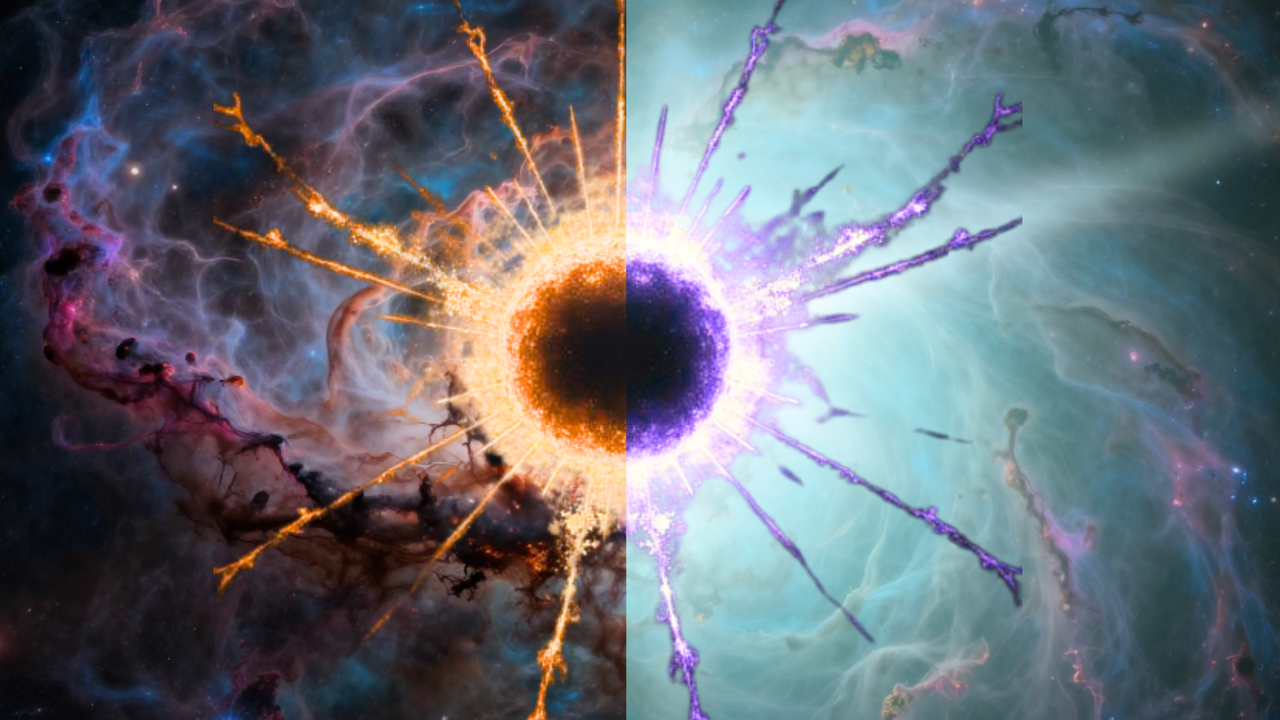
New research suggests that black holes born during the Big Bang could live much longer than previously estimated. In fact, these tiny primordial black holes may live long enough to become …
New research suggests that black holes born during the Big Bang could live much longer than previously estimated. In fact, these tiny primordial black holes may live long enough to become energy-spewing white holes with the mass of a human eyebrow hair. Primordial black holes are proposed to have formed through fluctuations in the incredibly hot and dense matter that filled the universe moments after the Big Bang . This is in contrast to stellar-mass or "astrophysical" black holes that are familiar to us the collapse of massive stars like the. Primordial black holes remain undetected and therefore hypothetical. Many scientists believe that the failure to detect astrophysical black holes is because they have evaporated and therefore no longer exist in the 13.8 billion year-old cosmos. This is possible because black holes are proposed to "leak" a type of thermal radiation called "Hawking radiation" proposed by Stephen Hawking in the 1970s. The smaller the mass of a black hole, the hotter it is, and thus the faster it leaks Hawking radiation and the more rapidly it evaporates, a process speculated to end with an explosive finale. Stellar-mass black holes, with up to hundreds of times the mass of the sun , are massive and cool enough to leak slowly enough to outlive the universe itself many times over; primordial black holes with masses way smaller than this, on the other hand, aren't so lucky — or so we thought. …
Original source: Space.com