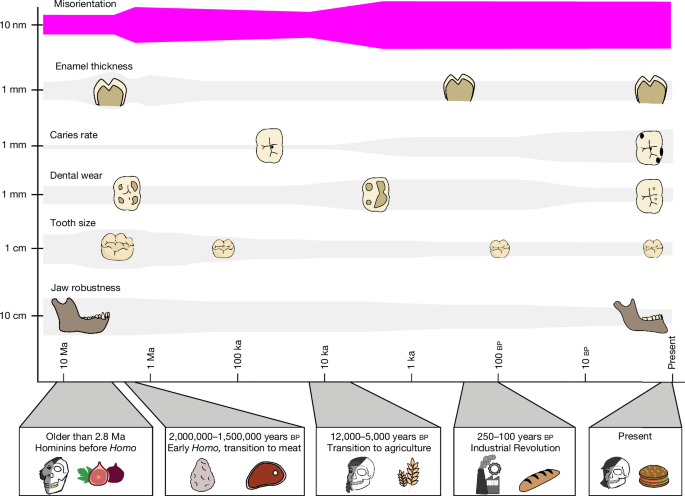
Enamel nanocrystal misorientation increased with meat-eating and agriculture
Nature News ·
Sample The nine species analysed in this study are listed in Supplementary Table 1 . The 12 tooth samples, locations of origin, date, collection ID and precise tooth analysed are listed in …
Sample The nine species analysed in this study are listed in Supplementary Table 1 . The 12 tooth samples, locations of origin, date, collection ID and precise tooth analysed are listed in Supplementary Table 2 . Whenever possible, we selected lower first molars (LM1) and the mesio-buccal cusp, which experiences crushing and grinding forces and is the first to wear 53 , 54 (Extended Data Fig. 2 ). When an LM1 was not available (for example, fossil samples), we used the functional cusp of the available molar or premolar, which is equivalent to an LM1’s mesio-buccal cusp in its masticatory function (Extended Data Fig. 2 ). In all cases, analysis was restricted to molar or premolar teeth and focused on the occlusal region proximal to the dentine horn to control for functional use and avoid worn enamel. Histological sample preparation Previous studies generated histological sections of PA, Arch1, Arch2, MH, Pt , Pp and Ca , but all used a standard set of histological methods 55 , 56 . Details of materials and consumables used for each sample can be found in their respective published articles (Supplementary Table 2 ). We identified no pathologies or taphonomic features in any sample. When wear was present, it was minimal and did not reach the dentine horn. All samples are permanent posterior teeth from adult individuals, with the exception of Ca , which was a subadult. Teeth were embedded in epoxy resin before being sectioned. …
Original source: Nature News