Bang! Exploding immune cells splatter potent toxins everywhere
Nature News ·
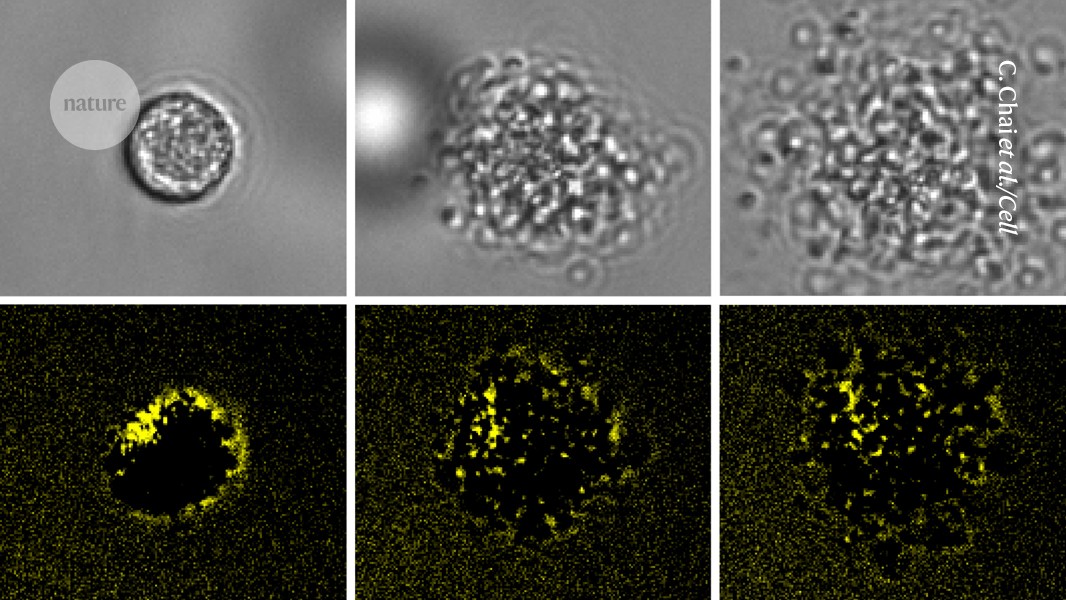
Intact immune cells (left column) had disintegrated (right column) only 100 seconds after their explosion was triggered by adding a hormone. …
Intact immune cells (left column) had disintegrated (right column) only 100 seconds after their explosion was triggered by adding a hormone. A cell’s plasma membrane (bottom row, yellow) started to rupture 60 seconds after the hormone was added. Credit: C. Chai et al./Cell New-found immune cells called ‘ruptoblasts’ explode when triggered, ejecting toxic chemicals capable of delivering death to surrounding cells in just minutes. The cells’ discoverers say that this process, which they call ruptosis, seems to be a new form of cell death that differs considerably from other known types. The findings 1 , which appear today in the journal Cell , “are very interesting and thought-provoking,” says Kristopher Sarosiek, a cell-death researcher at the Harvard T.H. Chan School of Public Health in Boston, Massachusetts, who was not involved in the research. Although other forms of cell death are similar, none are identical, he says, “making ruptosis a new phenomenon”. Vanishing cells The authors stumbled on the newly discovered cells while studying a species of planarian flatworm ( Schmidtea mediterranea ). P lanarians have long been of interest to scientists owing to their amazing regenerative capabilities — a single planarian cut into many pieces can regrow into a new worm. Planarians lack immune molecules called antibodies, but they do mount a robust immune response against pathogens as they regenerate. …
Original source: Nature News