Landmark cancer trial shows success against ‘undruggable’ cancer — raising hopes for future treatments
Nature News ·
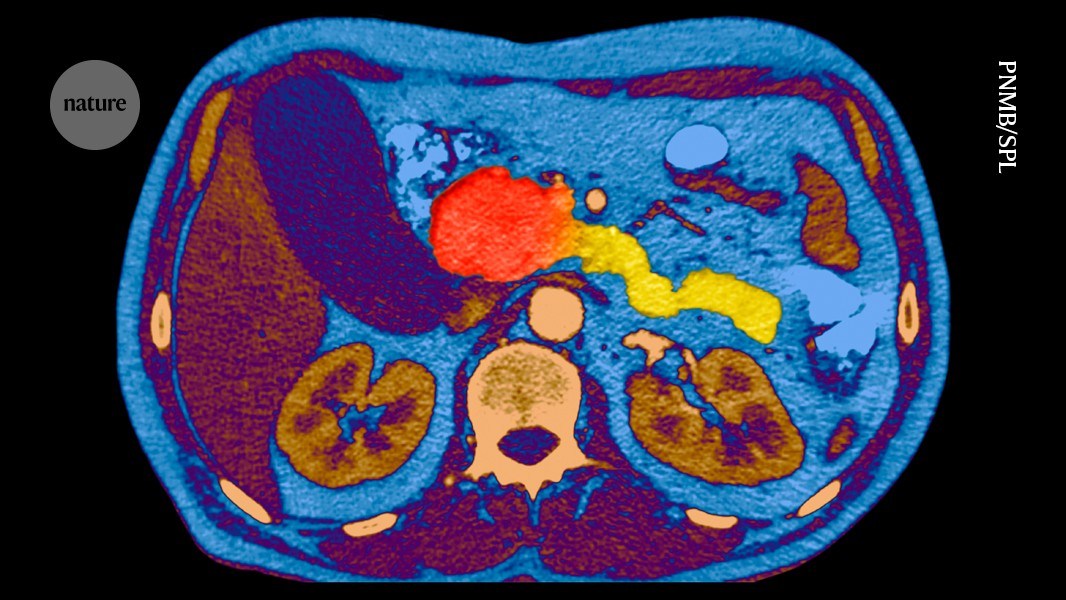
Pancreatic-head tumours (red, artificially coloured) have proven highly resistant to treatment, but a new drug nearly doubles the lifespan of people with this type of cancer. …
Pancreatic-head tumours (red, artificially coloured) have proven highly resistant to treatment, but a new drug nearly doubles the lifespan of people with this type of cancer. Credit: PNMB/Science Photo Library The landmark success of a drug against an ‘undruggable’ cancer is spurring fresh optimism in the quest to treat seemingly untouchable tumour targets. The experimental drug, daraxonrasib , disarms all three members of the RAS family of proteins, which are linked to some of the deadliest cancers. Designing drugs that target the RAS proteins has been notoriously challenging . But a large clinical trial has found that daraxonrasib nearly doubled survival — from 6.7 months to 13.2 months — in people with a form of advanced pancreatic cancer. The results were presented to a packed room at the American Society of Clinical Oncology annual meeting in Chicago, Illinois on 31 May, and published in the New England Journal of Medicine 1 . At the conference, the talk was met with a long standing ovation, says Ecaterina Dumbrava, an oncologist at the University of Texas MD Anderson Cancer Center in Houston. “After more than a decade without major advances in treatment for pancreatic cancer, seeing this is really emotional,” she says. That success is raising hopes that other challenging targets might also soon fall. Nature talked to researchers about progress in targeting RAS and other “undruggable” cancer proteins that can’t be bested with conventional approaches. …
Original source: Nature News
Mentioned
New Hampshire · San Francisco · United States · University of Texas · University of California,