Astronomers discover a 'lost world' of black hole mergers: 'It's the astronomical equivalent of uncovering an ancient civilization'
Space.com ·
Astronomers have struck "black gold" — a treasure trove of black hole mergers. And the discovery was made by analyzing ripples in the very fabric of space and time, or spacetime, called gravitational …
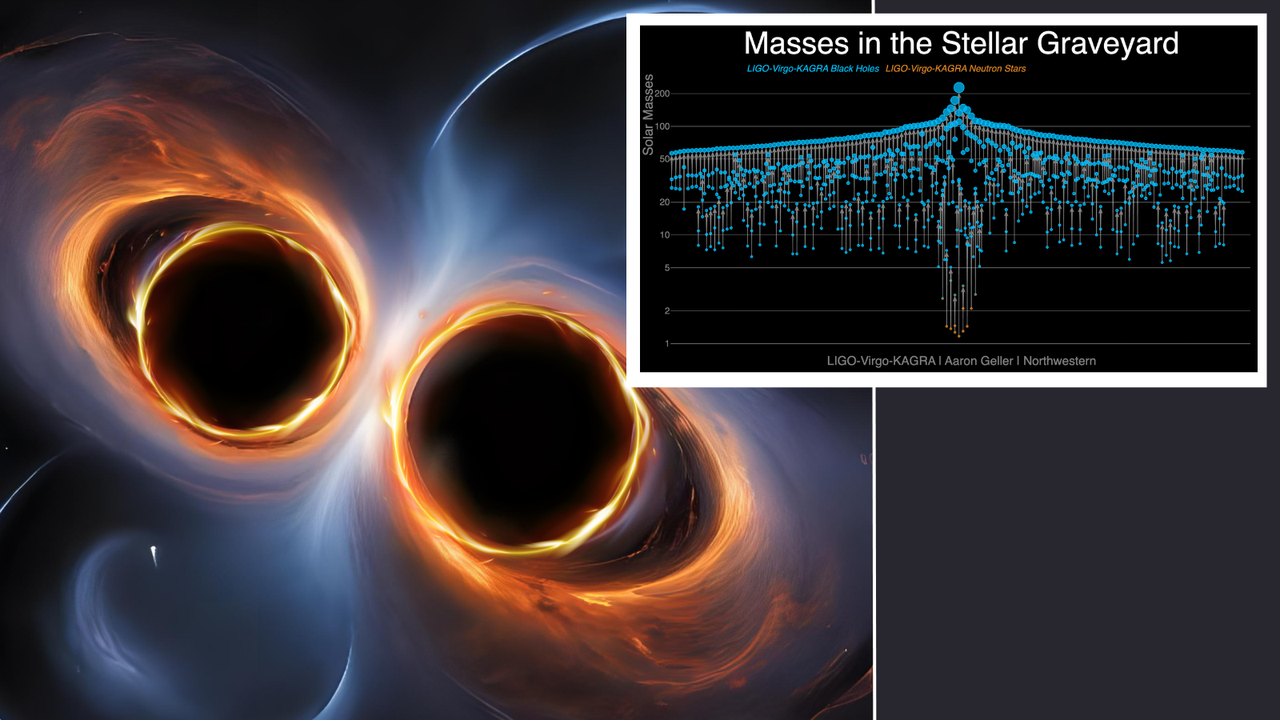
Astronomers have struck "black gold" — a treasure trove of black hole mergers. And the discovery was made by analyzing ripples in the very fabric of space and time, or spacetime, called gravitational waves. This massive haul of mergers contained within the Gravitational Wave Transient Catalogue-5.0 (GWTC-5), released on Tuesday (May 26), could change our understanding of how black holes meet and collide. The latest catalog contains 161 new gravitational wave signals launched by merging black holes "heard" by iconic gravitational wave detectors LIGO (Laser Interferometer Gravitational-Wave Observatory), Virgo, and KAGRA (Kamioka Gravitational Wave Detector) between April 2024 and the end of January 2025. It brings the total number of black hole mergers detected via gravitational waves up to 390. Highlights of GWTC-5 include the detection of "second generation mergers," or collisions between two black holes that had formed in previous mergers, and the most precisely localized merger ever. While the former could help us better understand merger chains that allow black holes to grow to masses millions or even billions of times that of the sun, the latter could help develop a method of using such events and their gravitational wave signals to measure the rate at which the universe is expanding. …
Original source: Space.com