Ebola can be stopped — but only if world leaders prioritize public health
Nature News ·
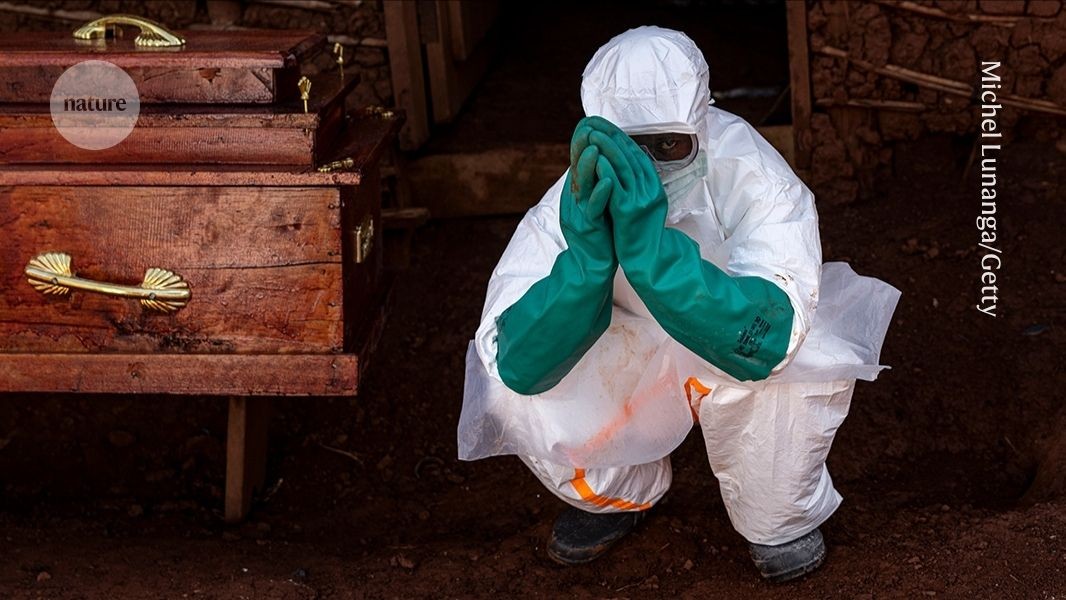
You have full access to this article via your institution. A community health worker next to a coffin of someone thought to have died from Ebola in Ituri province in the Democratic Republic of the …
You have full access to this article via your institution. A community health worker next to a coffin of someone thought to have died from Ebola in Ituri province in the Democratic Republic of the Congo. Credit: Michel Lunanga/Getty Half a century ago, researchers and policymakers joined together to identify an unknown disease and bring it under control. That first Ebola outbreak took 280 lives from 318 cases in what is now the Democratic Republic of the Congo (DRC). After it was reported in September 1976, rapid action — an organized campaign of surveillance, contact tracing, isolating cases and safe burials — meant that the outbreak was over within four months 1 . Ebola outbreak: the data that show why researchers are so alarmed Now, 50 years later, Central African countries are again in the middle of a serious outbreak, and one that was detected far too late. As Nature ’s news team and others have reported (see Nature https://doi.org/q8r6; 2026 ), the virus responsible for the current outbreak, a rare species of Ebola virus called Bundibugyo, was probably circulating for months before any cases were reported. The very first case has still not been identified. By the time World Health Organization (WHO) director-general Tedros Adhanom Ghebreyesus declared a public-health emergency of international concern (PHEIC) on 17 May, there had been 8 laboratory-confirmed cases, 246 suspected cases and 80 suspected deaths. …
Original source: Nature News
Mentioned
Jean Kaseya · Donald Trump · New York City · United States · Springer Nature · Central African Republic · World Health Organization · Tedros Adhanom Ghebreyesus