A direct black-hole mass measurement in a little red dot at high redshift
Nature News ·
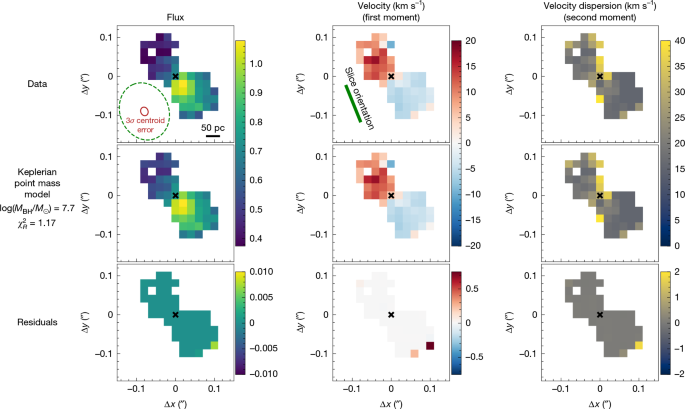
Conventions Throughout this work we assume a flat Λ (dark energy) cold-dark-matter cosmology with matter density parameter Ω m = 0.315 and a Hubble constant H 0 = 67.4 km s −1 Mpc −1 (ref. 46 ). …
Conventions Throughout this work we assume a flat Λ (dark energy) cold-dark-matter cosmology with matter density parameter Ω m = 0.315 and a Hubble constant H 0 = 67.4 km s −1 Mpc −1 (ref. 46 ). All reported magnitudes are in the AB system. Following the lensing model of ref. 13 , we adopt a flux magnification factor μ = 6.2 and a shear factor of 3.52 for our source (image A of QSO1). Hence, 1 arcsec in the image plane corresponds to 1.52 physical kiloparsecs. For robustness tests, we use the Bayesian information criterion (BIC), defined as BIC ≡ χ 2 + k ln n , where k is the total number of model parameters and n is the number of points fitted; a decrease in BIC, ΔBIC ≥ 5, between two models was required for robust preference of one over the other, although our main conclusions remain unchanged even if a stricter ΔBIC ≥ 10 threshold is adopted. Data reduction We use data from the BlackTHUNDER NIRSpec integral field unit survey, focusing on the 7.3-hour exposures with the G395H grating, giving a nominal spectral resolution R = 3,700 at the wavelength of Hα 15 . The NIRSpec integral field unit was centred on image A of QSO1 (right ascension 00:14:19.161; declination −30:24:05.664) 12 . A detailed description of the reduction procedures is available in refs. 4 , 15 ; however, a summary is provided here for context. The spectra were extracted following the procedures of ref. 47 , but using version 1.17.1 of the JWST pipeline. …
Original source: Nature News