Four ppm measurement of the antihydrogen ground-state hyperfine splitting
Nature News ·
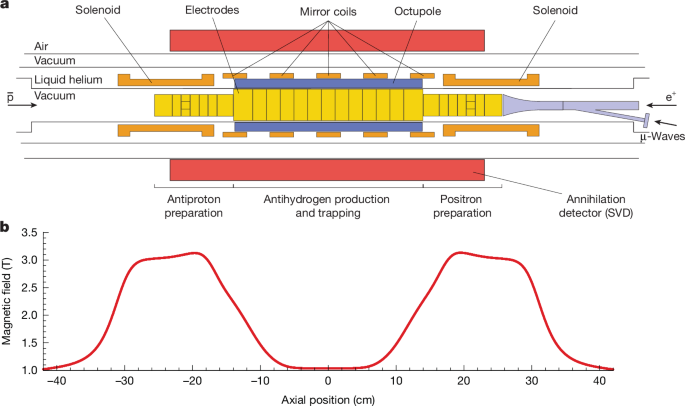
Trap magnetic field profile, stabilization and characterization The design of the flattened magnetic field profile along the axis at the centre of the trap in the trapping region, shown in Fig. …
Trap magnetic field profile, stabilization and characterization The design of the flattened magnetic field profile along the axis at the centre of the trap in the trapping region, shown in Fig. 1 , represents an important component of the gains in frequency resolution reported here. In particular, the curvature of the magnetic field governs the timescale over which anti-atoms interact with the microwave field as they are brought into resonance. In round numbers, the second axial derivative of the axial magnetic field profile used in the current work is less than 2 T m − 2 , or a factor of 20 smaller than that of the (unflattened) trapping field used during the measurement of the hyperfine splitting reported in ref. 15 . This, in turn, enhances positron spin-flip efficiencies and our ability to probe anti-atoms much closer to the minimum frequencies of the two transitions. However, unlike the maximally flattened field configurations used in previous optical spectroscopy experiments 13 , 39 , here we intentionally depress the field below the central mirror coil by about 5 × 10 −5 T to ensure the existence of a shallow, centrally located absolute minimum (Extended Data Fig. 1 ). We use the electron cyclotron resonance (ECR) technique to map the axial magnetic field profile along the axis of the trap in situ with a frequency resolution of the order of 1 ppm (ref. …
Original source: Nature News