How the connection between lung cancer and the brain could lead to better treatments
Nature News ·
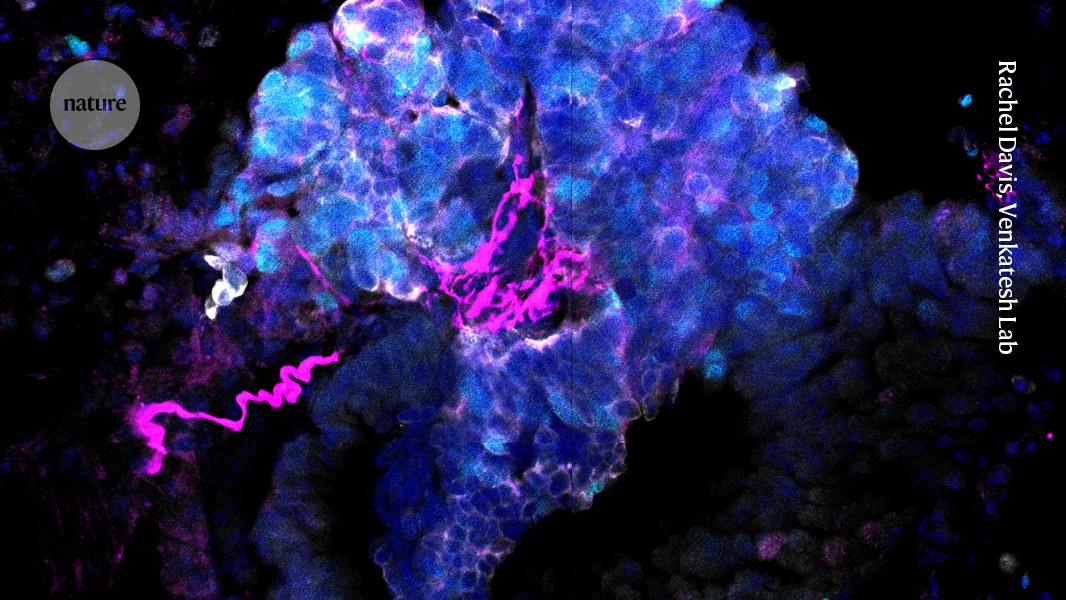
Neurons (magenta) innervate a small cell lung cancer tumour. Credit: Rachel Davis, Venkatesh Lab At first, Filippo Beleggia had no interest in neurons. …
Neurons (magenta) innervate a small cell lung cancer tumour. Credit: Rachel Davis, Venkatesh Lab At first, Filippo Beleggia had no interest in neurons. A cancer biologist studying small-cell lung cancer (SCLC), he deployed a sophisticated screening technique to search for genes that drive tumour progression in a mouse model of the disease. Although it accounts for only around 15% of lung cancers, SCLC is the most aggressive and metastatic form of the disease and has limited options for treatment. Beleggia was hoping to identify genes involved in processes such as cell division or responses to DNA damage, and says his aim was to discover genes “that we could then build therapies on”. What this first screen delivered, however, was a list of genes implicated in neurobiology. Such was the surprise, Beleggia says, that his team dismissed it as an artefact of the technique they had used. Nature Outlook: Lung cancer It was known that a high fraction of cells in SCLC tumours resemble neuroendocrine cells — with the lung’s native neuroendocrine cells being the suspected origin of these tumours. Given that such cells release hormones or neurotransmitters and express a handful of neuronal markers. Beleggia saw the result as a “by-product of this neuroendocrine differentiation”, adding that the phenomenon “doesn’t really have any relevance for the cancer state”. He and his colleagues at the University of Cologne in Germany therefore ran a second large-scale screen, then a third. …
Original source: Nature News
Mentioned
London · Germany · Cambridge · California · Massachusetts · Harvard University · Stanford University