Meet the biologists deciphering marine-mammal histories from baleen, whiskers and tusks
Nature News ·
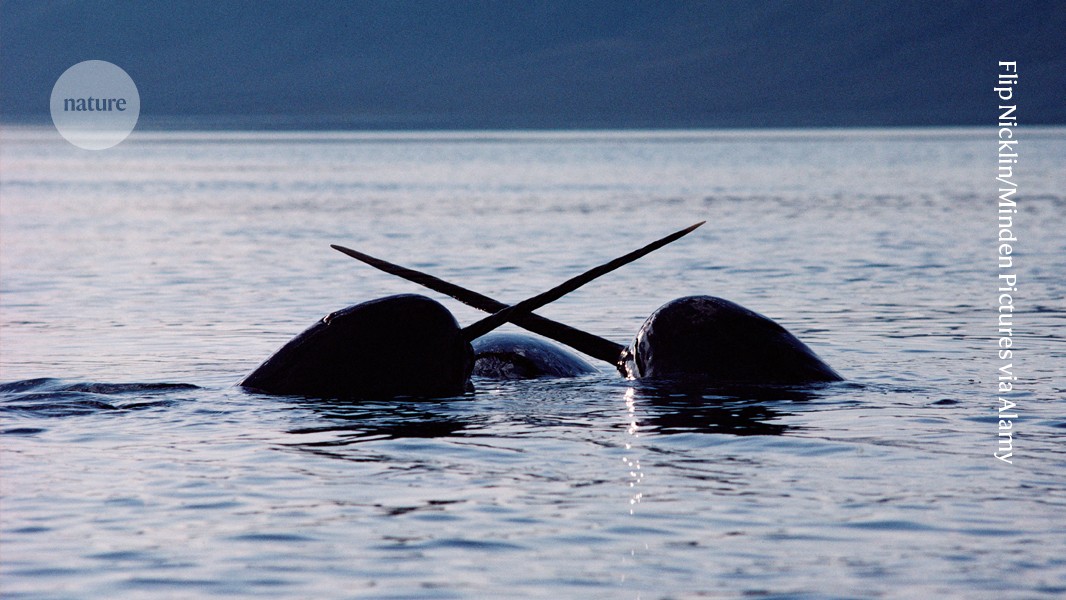
Male narwhals fighting over the carcass of a female off Baffin Island, Canada. Credit: Flip Nicklin/Minden Pictures via Alamy In March, Kathleen Hunt unpacked the first shipments of equipment and …
Male narwhals fighting over the carcass of a female off Baffin Island, Canada. Credit: Flip Nicklin/Minden Pictures via Alamy In March, Kathleen Hunt unpacked the first shipments of equipment and samples at her new laboratory at Oregon State University’s Marine Mammal Institute in Newport, on the Pacific coast. On empty benches, the conservation biologist began setting up centrifuges, a spectrophotometer, drills to turn samples into powder and a station for performing biochemical assays. But her most prized possessions were shrouded in orange bubble wrap. As she removed a 2-metre-long plate of keratin that looks like horsehair trapped in fingernails, she lamented her clumsy first attempts, back in 2013, to sample it for hormones. Five-centimetre-long punctures where her drill bit pierced the material are visible every few centimetres, along striations that seemed to represent growth lines. “We took enormous amounts of powder because, at the time, we thought we needed it,” she explains. Hello puffins, goodbye belugas: changing Arctic fjord hints at our climate future The plate is baleen, or whalebone, which North Atlantic right whales ( Eubalaena glacialis ) and a dozen or so other species use to filter plankton, krill and other food. Each plate can range from 0.5 to 2.5 metres in length, and whales can have several hundred of them hanging from each side of the upper jaw. …
Original source: Nature News