'Very interesting wiggles' in data from silent NASA Mars spacecraft lead to unexpected solar wind discovery
Space.com ·
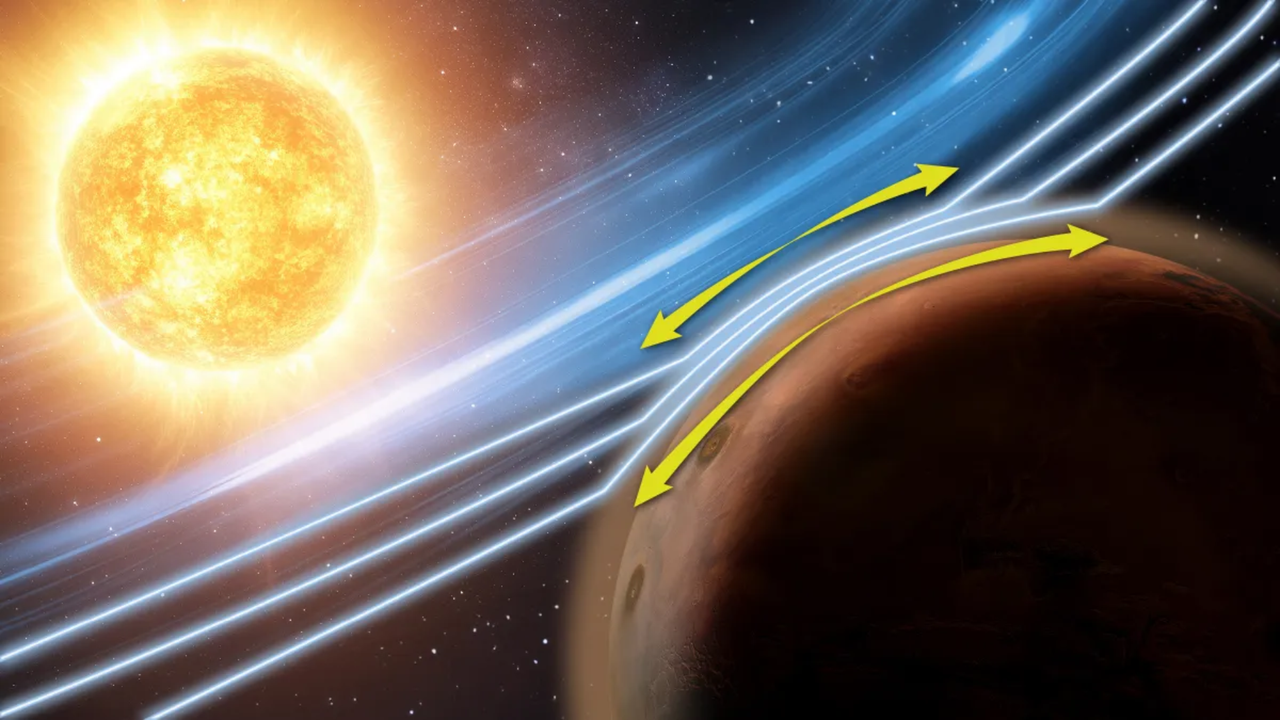
Even as NASA continues to try to restore contact with the MAVEN spacecraft after it fell silent in late 2025, scientists analyzing its data have spotted a phenomenon in Mars’ atmosphere that, until …
Even as NASA continues to try to restore contact with the MAVEN spacecraft after it fell silent in late 2025, scientists analyzing its data have spotted a phenomenon in Mars’ atmosphere that, until now, had only been observed around strongly magnetized planets like Earth. The finding could help scientists better understand how space weather shapes worlds without protective magnetic shields, including planets such as Venus and Saturn's largest moon Titan , the researchers say. The phenomenon, known as the Zwan-Wolf effect, helps deflect the solar wind — the constant stream of charged particles flowing from the sun — as it encounters a planet’s magnetic environment. On Earth, a powerful magnetic field generated deep within the planet's core creates a vast protective bubble, or magnetosphere, that continuously redirects those particles around the planet. Mars, however, lost most of its global magnetic field billions of years ago and today possesses only a much weaker, patchier magnetic environment formed when the solar wind interacts directly with the planet’s thin upper atmosphere. This makes the new finding especially surprising, researchers say. Until now, the Zwan-Wolf effect had only been observed in the large magnetospheres surrounding strongly magnetized planets, not deep within a planetary atmosphere. "No one expected that this effect could even occur in the atmosphere," Christopher Fowler, a professor at West Virginia University who led the study, said in a statement . …
Original source: Space.com
Mentioned
NASA · Texas · titan · Venus · Earth · MAVEN · Saturn · Nature Communications