How I eavesdrop on frog conversations
Nature News ·
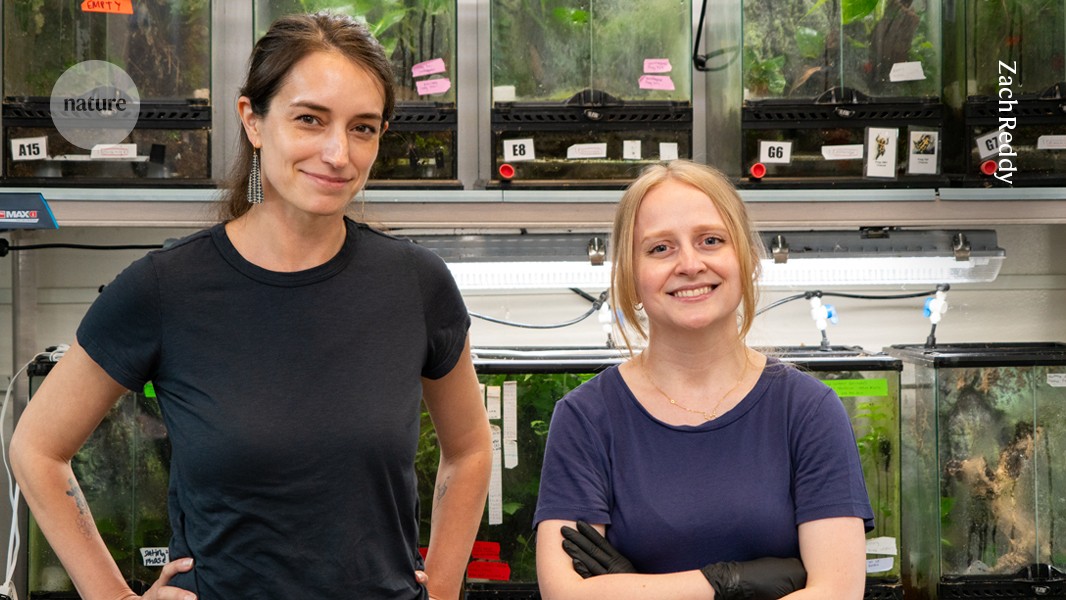
Billie Goolsby (right) and Lauren O’Connell study parent–offspring communication in frogs. Credit: Zach Reddy Working scientist profiles This article is part of an occasional series in which Nature …
Billie Goolsby (right) and Lauren O’Connell study parent–offspring communication in frogs. Credit: Zach Reddy Working scientist profiles This article is part of an occasional series in which Nature profiles scientists with unusual career histories or outside interests. When the tadpoles of some poison frogs talk to their parents, they don’t croak or sing. Instead, they speak in a language of vibration, performing a wriggling dance against their mother’s or father’s body. The parents somehow judge their offspring’s hunger from this vibration. Scientists don’t yet know exactly how the tadpole vibrations translate into parental marching orders. But when Billie Goolsby started her PhD research at Stanford University in California in 2020, she felt uniquely equipped to investigate the question. Goolsby was born hard of hearing, and her mother spoke to her using a language that, like the amphibians’ communication, included touch. A sit in the sauna can save endangered frogs “Parent–offspring communication is often the most crucial and the primary interaction that social creatures have,” Goolsby says. “Parents really care about what their babies say.” The various species of poison frog that Goolsby’s PhD adviser, Lauren O’Connell, studies in the laboratory care for their young in ways that might seem surprising. In many species, fathers give their newly hatched tadpoles piggybacks to pools of water, such as rainwater cupped in a leaf. …
Original source: Nature News
Mentioned
PhD · Georgia · California · Massachusetts · Boston University · Stanford University