A deep-learning framework reveals whole-body perturbations at cell level
Nature News ·
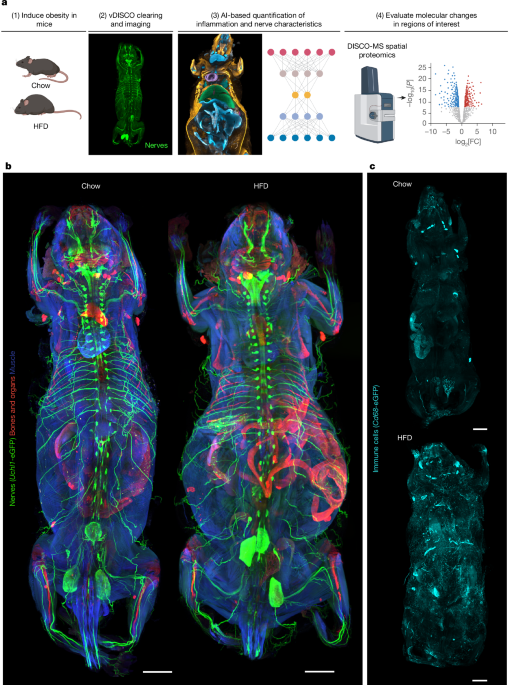
Animals Male Uchl1- eGFP and Cd68- eGFP mice (aged 8 weeks) on the C57BL/6J background or wild-type C57BL/6J mice were fed either a chow diet or a high-fat diet (60% fat, D12492i from Research Diets) …
Animals Male Uchl1- eGFP and Cd68- eGFP mice (aged 8 weeks) on the C57BL/6J background or wild-type C57BL/6J mice were fed either a chow diet or a high-fat diet (60% fat, D12492i from Research Diets) for 16–18 weeks ad libitum. Mice were maintained on a 12 h–12 h light–dark cycle. The set points in the animal room were adjusted to 20–24 °C temperature and 45–65% humidity. Body composition was determined using an EchoMRI-100H system (EchoMRI). For insulin-tolerance tests, mice were fasted for 6 h and intraperitoneally (i.p.) injected with 0.75 U kg −1 insulin. Blood glucose was measured from the tail vein at the indicated timepoints using glucose test stripes. Mice were euthanized after deep anaesthesia with a mix of ketamine and xylazine, followed by intracardiac perfusion with heparinized PBS (10 U ml −1 heparin) and by a perfusion with 4% paraformaldehyde (PFA). Mice were post-fixed overnight in 4% PFA and subsequently washed five times with PBS shaking (300 rpm) at room temperature for 1 h for each wash step. Animal experimentation was performed in accordance with the European Union directives and the German animal welfare act (Tierschutzgesetz). They have been approved by the state ethics committee and the government of Upper Bavaria (ROB-55.2-2532.Vet_02-21-133, ROB-55.2-2532.Vet_02-16-117, ROB-55.2-2532.Vet_02-17-49, ROB-55.2-2532.Vet_02-19-166). …
Original source: Nature News