Nonlinear atomic tunnelling boosted by bright squeezed vacuum
Nature News ·
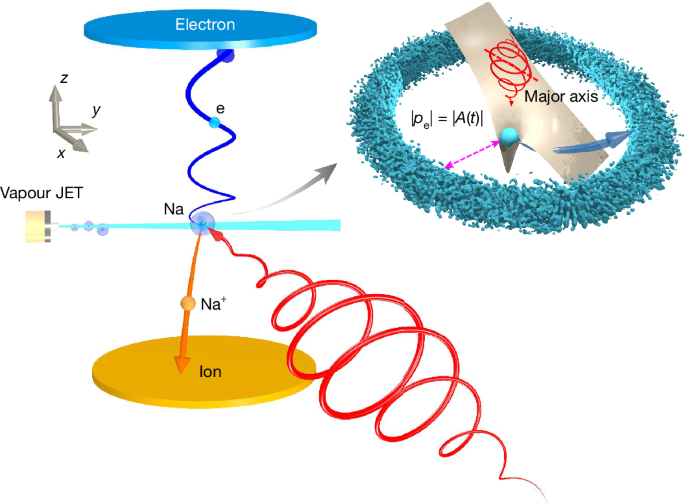
Experimental details Both coherent and quantum light sources are pumped with the same femtosecond laser pulse (790 nm, 28 fs, 10 kHz) generated by a Ti:sapphire multipass amplifier laser system …
Experimental details Both coherent and quantum light sources are pumped with the same femtosecond laser pulse (790 nm, 28 fs, 10 kHz) generated by a Ti:sapphire multipass amplifier laser system (Femtolaser). The coherent light source centred at 1,580 nm and with a pulse duration of 70 fs, is produced by a commercial optical parametric amplifier (Light Conversion, TOPAS-Prime). For the quantum BSV light source, the pump beam collimated to a 4-mm diameter is propagated through two cascaded 3-mm BBO crystals. Both BBO crystals are cut for type-I collinear frequency-degenerate phase matching to generate high-gain parametric down-conversion. Here, the optical axes are oriented oppositely in the horizontal plane to minimize the spatial walk-off. The distance between two crystals is set at 80 cm so that only the spatial mode with the lowest diffraction undergoes the phase-sensitive amplification. The pulse duration of the BSV light is measured to be approximately 150 fs using the technique of cross-correlation frequency-resolved optical gating based on sum-frequency generation of the to-be-calibrated BSV pulse and a reference infrared pulse. The effect of different pulse durations for coherent and BSV lights is discussed in the section ‘ Effect of pulse duration ’. The second-order correlation function g (2) of the generated BSV is measured using the standard Hanbury Brown–Twiss technique. …
Original source: Nature News