Mouse eyes photosynthesize after plant-to-animal transplant
Nature News ·
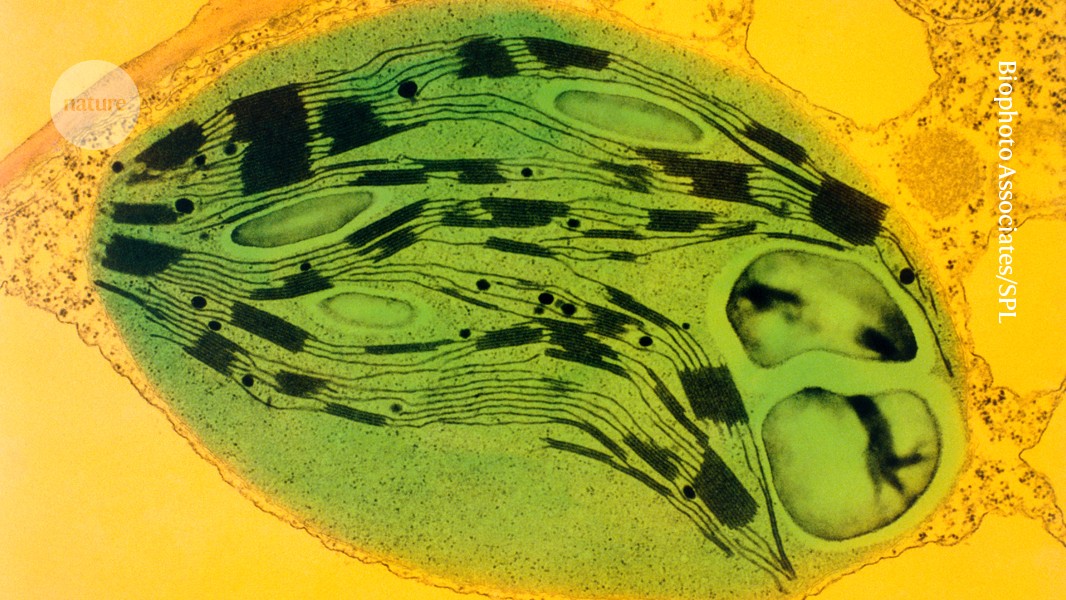
A chloroplast (green) dotted with the membranous stacks called thylakoid grana (black blocks). Scientists have harnessed grana to induce photosynthesis in mammalian cells. …
A chloroplast (green) dotted with the membranous stacks called thylakoid grana (black blocks). Scientists have harnessed grana to induce photosynthesis in mammalian cells. Credit: Biophoto Associates/Science Photo Library Photosynthetic machinery can be harvested from spinach and transplanted into the eyes of mice, where it transforms light into molecules that carry energy and can tame inflammation 1 . “We are stealing the entire technology that has evolved over millions of years in plants and are able to transplant it into the animal system,” says David Tai Leong, a biologist at the National University of Singapore and co-author of the study. “This is really cool,” says Corey Allard, a cell biologist at Harvard University in Cambridge, Massachusetts. The findings, published today in Cell , suggest that plant-to-animal organelle swaps could lead to fresh biological insights as well as therapeutic applications. “Any effort to do this is necessarily going to look like a party trick at first,” Allard adds. But only by trying the technique and finding out its limitations — such as how long the effects last and which cells can be targeted — can researchers work to build out the use cases, he adds. Spinach smoothies Kuoran Xing, a bionanotechnologist at the National University of Singapore, and his colleagues were inspired to explore the potential of cross-kingdom transplants by the ability of sea slugs to steal photosynthetic machinery from algae. …
Original source: Nature News