James Webb Space Telescope maps our universe's largest structure in unprecedented detail
Space.com ·
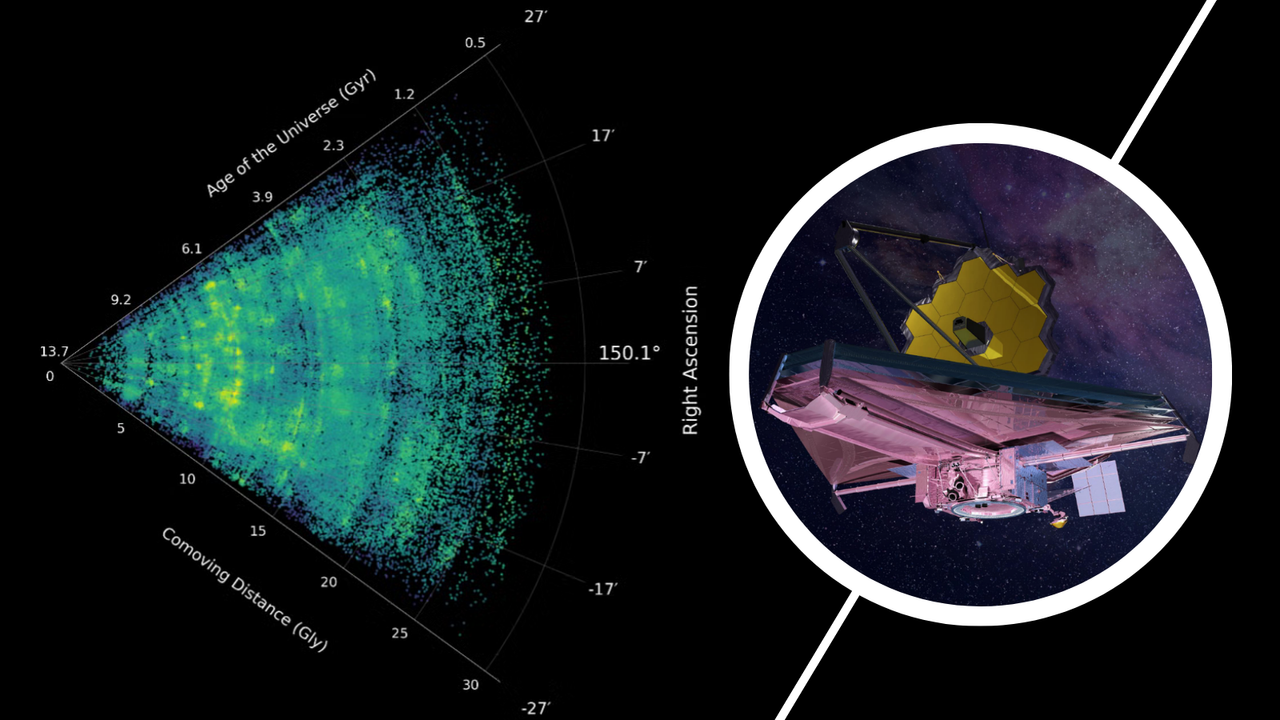
Using the James Webb Space Telescope, astronomers have mapped the "cosmic web" of galaxies — the largest structure in the universe — with unprecedented detail. …
Using the James Webb Space Telescope, astronomers have mapped the "cosmic web" of galaxies — the largest structure in the universe — with unprecedented detail. This is the largest James Webb Space Telescope (JWST) survey conducted to date, and is known as COSMOS-Web. It traces a network of galaxies back to when the universe was about 1 billion years old. The cosmic web is the term scientists use to describe a skeleton-like framework of filaments and sheets of dark matter and gas along which galaxies gathered and evolved over time, which is punctuated by nearly empty voids. Thus, the cosmic web forms the architecture of the universe — it's a singular, intricate, far-reaching structure that traps galaxies and galactic clusters like flies strung along the sticky silk web of a greedy spider. The results obtained by the COSMOS-Web team further demonstrate the power of the JWST to refine and redefine our view of the universe since the $10 billion space telescope began beaming data back to Earth in the summer of 2022. "JWST has completely changed our view of the universe, and COSMOS-Web was designed from the start to give us the wide, deep view we need to see the cosmic web," leader of this research, Hossein Hatamnia of the University of California, Riverside (UCR), said in a statement . …
Original source: Space.com
Mentioned
JWST · Earth · Astrophysical Journal · Hubble Space Telescope · University of California · James Webb Space Telescope