Did <i>Homo erectus</i> and Denisovans mate? Tooth proteins hint at ancient trysts
Nature News ·
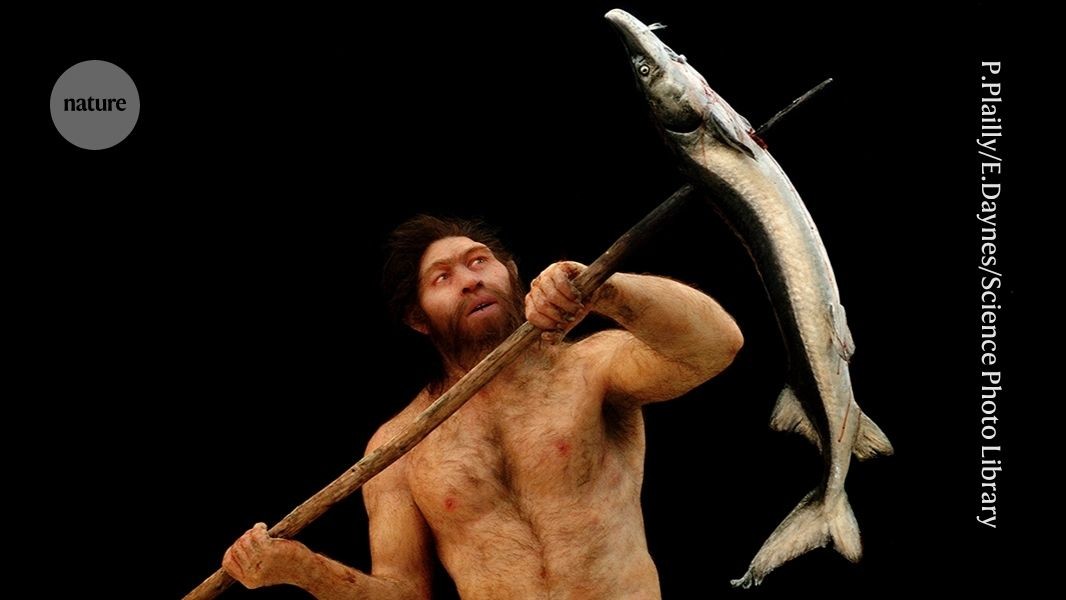
Ancient proteins were extracted from the tooth enamel from several Homo erectus individuals, including 'Peking man', illustrated above. …
Ancient proteins were extracted from the tooth enamel from several Homo erectus individuals, including 'Peking man', illustrated above. Credit: P.Plailly/E.Daynes/Science Photo Library It is well known that human relatives interbred: Homo sapiens with Neanderthals , Neanderthals with Denisovans , Denisovans with Homo sapiens . Now there is evidence for another ancient tryst, between Denisovans and Homo erectus . That’s according to an analysis of ancient proteins extracted from the teeth of six H. erectus individuals that lived in China 400,000 years ago. The work, published in Nature today, is the first genetic evidence of the pairing 1 . H. erectus played a pivotal part in human history. The species lived over a period from 1.9 million to just 100,000 years ago, a time when Neanderthals, their relatives the Denisovans, and early modern humans all roamed the Earth. H. erectus was also the first human relative to venture out of Africa and into Eurasia, and as far afield as the Indonesian island of Java in southeast Asia. Genetic data has been obtained from just a single H. erectus specimen from Georgia, dating to 1.8 million years ago 2 . But researchers were unable to identify any unique genetic variants that might distinguish H. erectus from other human relatives. In China, researchers have found H. erectus remains of varying ages at more than a dozen sites, making it a potential treasure trove for uncovering genetic data for the species. …
Original source: Nature News