White matter micro- and macrostructure brain charts for the human lifespan
Nature News ·
Ethics The research consists of secondary analyses of de-identified primary datasets. Information regarding informed consent of participants (or guardians) in primary studies can be found in the …
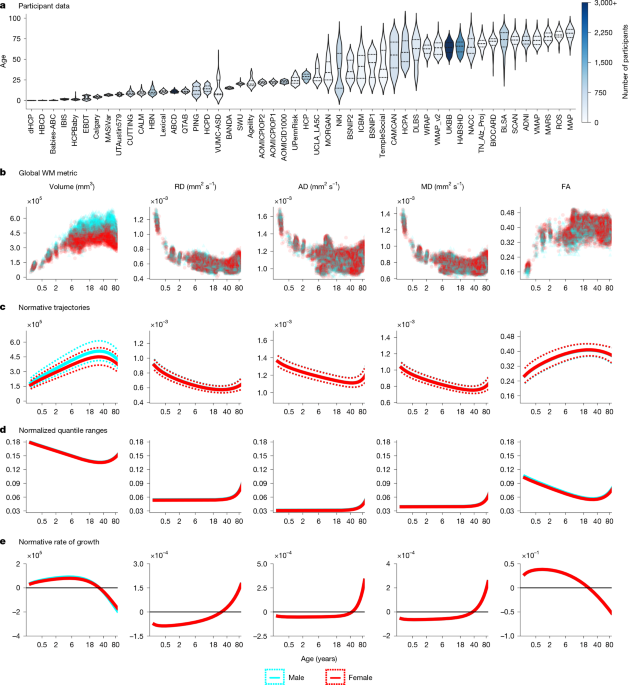
Ethics The research consists of secondary analyses of de-identified primary datasets. Information regarding informed consent of participants (or guardians) in primary studies can be found in the references in Supplementary Table S2.T2 . Secondary analysis of these data was also approved by the Vanderbilt University Medical School Institutional Review Board (IRB no. 210968). Software reporting All analysis visualizations and statistics were generated using Python v3.9.20. Notable Python libraries used are pandas (v2.2.3), numpy (v2.0.2), seaborn (v0.13.2), matplotlib (v3.9.2), rpy2 (v3.5.11) and scipy (v1.13.1). For creating 3D qualitative visualizations of WM tracts, we used the mrview tool inside the MRtrix3 (version 3.0.4). Alternatively, for qualitative region of interest 3D visualizations, the OpenDIVE visualization library (v0.3.0) was used with a different Python (v3.10.18) for library compatibility purposes. Regarding the image preprocessing and processing software, please refer to ‘MRI processing pipeline’. Data We aggregated diffusion-weighted imaging (DWI) and T1-weighted (T1w) data from 50 independent studies spanning 0 to 100 years of age (Extended Data Table 1 ), encompassing 75,036 DWI scans from cognitively normal and clinical participants. All data were converted from DICOM to NIfTI using dcm2niix and organized in BIDS format in accordance with previous work 44 . …
Original source: Nature News