More concentrated precipitation decreases terrestrial water storage
Nature News ·
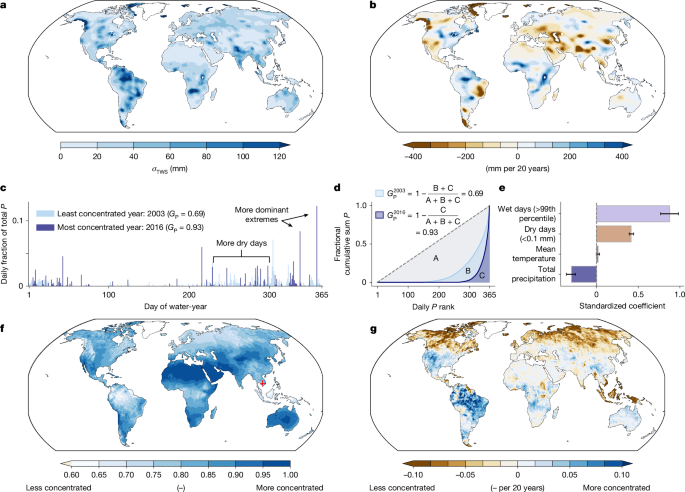
Data TWS data come from the GRACE and GRACE-FO mass concentration solutions (RL06) developed by the Center for Space Research at the University of Texas 25 . …
Data TWS data come from the GRACE and GRACE-FO mass concentration solutions (RL06) developed by the Center for Space Research at the University of Texas 25 . The dataset represents monthly total water mass variations (expressed as equivalent water height) at a gridded resolution of 0.25°. We omit data before August 2002 (due to sensor calibration at the outset of the GRACE mission) and for water-year 2017 (due to incomplete data during the mission gap between GRACE and GRACE-FO). We use GRACE TWS because it is an observational data product that holistically measures land water, capturing all surface and underground stocks. To account for observational uncertainty, we use three daily gridded precipitation data products: the Global Precipitation Climatology Project (GPCP) Daily Precipitation Analysis v.1.3 (ref. 21 ), the Global Precipitation Climatology Center (GPCC) Daily Analysis v.2022 (ref. 23 ) and the National Oceanic and Atmospheric Administration Climate Prediction Center (CPC) Unified Gauge-Based Analysis 22 . GPCC is a station-based product (1° resolution) with coverage over 1982–2020, whereas CPC (0.5°) and GPCP (1°) integrate station and satellite observations over 1979–2022 and 1997–2022, respectively. We repeated our analysis for the more recent GPCP v.3.3 and find consistent main effects 56 (Supplementary Fig. 4 ), but use the more complete earlier version for our main analysis (GPCP v.3.3 contains missing daily values at high latitudes after 2020). …
Original source: Nature News