New Ultra-Black Coating Could Enable the Search for Life on Exoplanets
NASA Breaking News ·
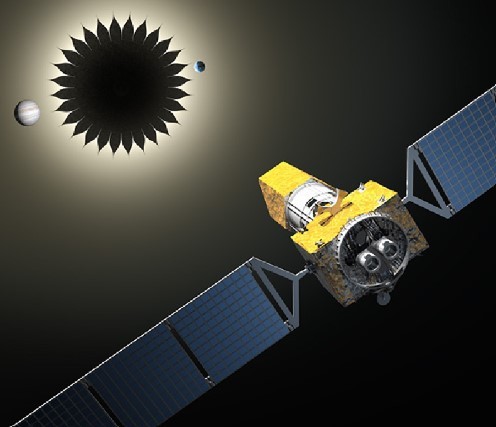
A recently developed ultra-black coating not only efficiently absorbs light, but is also extremely thin and durable, enabling its potential use on starshades that could someday support the imaging of …
A recently developed ultra-black coating not only efficiently absorbs light, but is also extremely thin and durable, enabling its potential use on starshades that could someday support the imaging of exoplanets and potentially facilitate the detection of life beyond our solar system. The light emitted by a star can be billions of times brighter than the light reflected from its surrounding planets. This bright starlight makes it very difficult for a space telescope to image an exoplanet — it’s like trying to find the light reflected from a gnat that is flying near a spotlight. In addition, the light from our Sun scatters off spacecraft surfaces and back into the telescope, contributing even more light “pollution” that can easily obscure the dim light reflected from an exoplanet. A starshade is a giant, flower-shaped spacecraft (roughly half the size of a football field) that is designed to be positioned between a space telescope and a distant star so that it casts a shadow from the distant star onto the telescope. A starshade can block unwanted light from the parent star to the extent that less than one part per billion of the starlight is observable, while allowing the much fainter light from an orbiting exoplanet to pass around the starshade and reach the telescope, thereby enabling its detection. But to enable a telescope to distinguish an exoplanet, a starshade must create an extremely pristine shadow on the telescope. …
Original source: NASA Breaking News